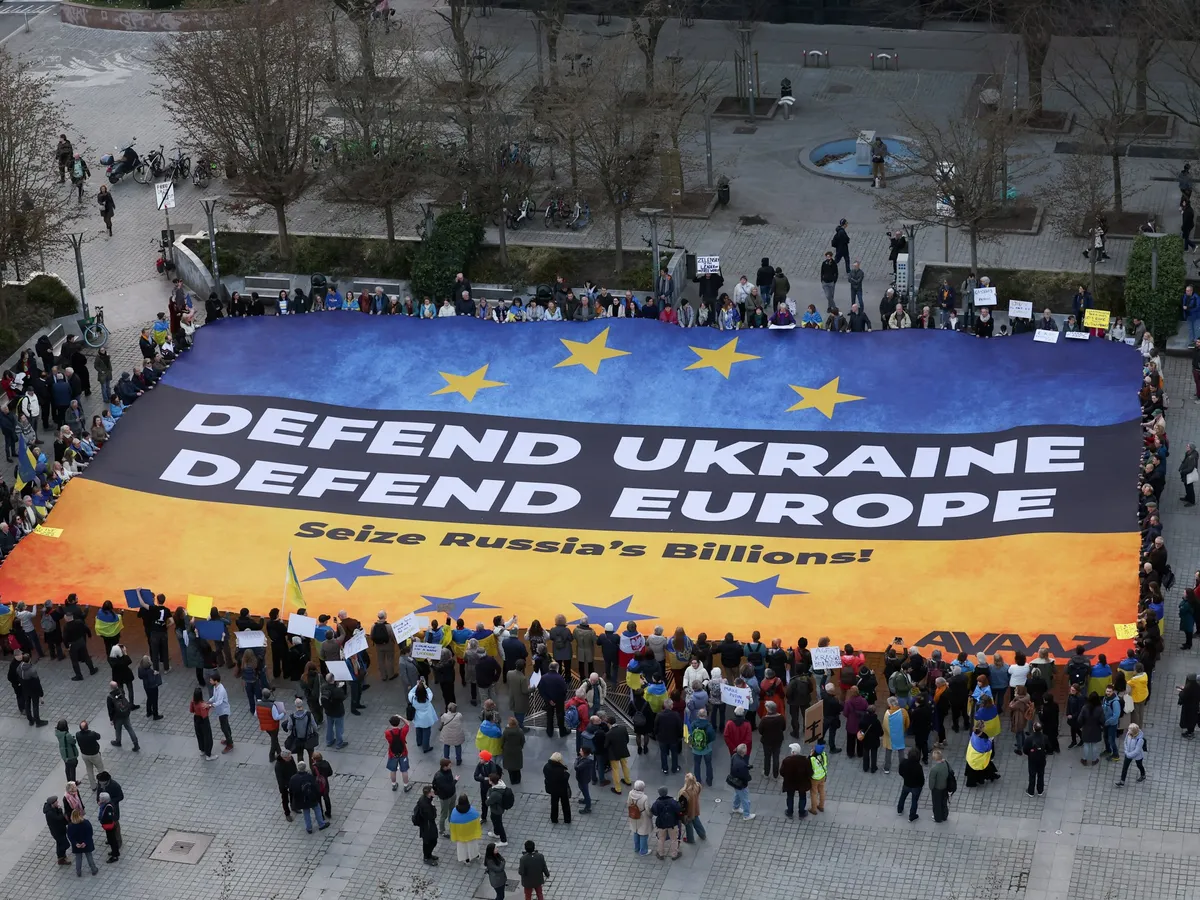
But Belgium, a vocal critic of the plan to use Russian assets to back Ukraine, says its concerns have not been resolved.Ukrainian activists deploy a massive banner urging European leaders to seize frozen Russian assets in Brussels, Belgium, on March 5, 2025 [Yves Herman/Reuters]Published On 4 Dec 2025The European Commission has proposed an unprecedented use of frozen Russian assets or international borrowing to raise 90 billion euros ($105bn) to support Ukraine’s war effort against Russia, though critical reservations about the plan from key stakeholder Belgium appear unresolved.The announcement by the European Union’s executive body on Wednesday proposed “two solutions to address Ukraine’s financing needs” for 2026 and 2027.Recommended Stories list of 3 itemslist 1 of 3Russia-Ukraine war: List of key events, day 1,378list 2 of 3‘Closing the tap’: EU agrees on deal to end Russian gas imports by 2027list 3 of 3Ukraine’s NATO membership ‘key question’ in US talks: Russiaend of listThe first option is an EU loan to Kyiv sourced from the private market, while the second preferred option is a “reparations loan” funded using Russian state assets frozen in the EU in response to Moscow’s 2022 invasion of Ukraine.“[These options] reflect the EU’s commitment to supporting Ukraine not only in defending its sovereignty and maintaining state functions, but also as a strategic investment in Europe’s security and in the pursuit of a just and lasting peace,” the Commission said in a press release.Commission President Ursula von der Leyen told reporters that the proposals will ensure Ukraine “has the means” to defend itself, “and take forward peace negotiations from a position of strength”.“We are proposing to cover two-thirds of Ukraine’s financing needs for the next two years. That’s 90 billion euros. The remainder would be for international partners to cover,” she said.“We are increasing the cost of Russia’s war of aggression. And this should act as a further incentive for Russia to engage at the negotiating table,” von der Leyen added.The Commission president suggested that the proposal to EU member states had taken into account almost all the concerns raised by Belgium, whose Brussels-based financial institution Euroclear is the main holder of the frozen Russian assets.Von der Leyen said the new proposal also covers other financial institutions in the EU holding Russian assets, while EU officials said France, Germany, Sweden and Cyprus also hold such assets that will be used to fund the proposed loan.The Commission also said the scheme does not amount to confiscating the money as it would be in the form of a loan – although Ukraine would only have to redeem it if Russia pays reparations for the war damage caused.The EU could proceed with the frozen assets proposal if 15 out of 27 members vote in favour. The Commission said it hoped to clinch a firm commitment from member states at an EU leaders summit on December 18.The second option – borrowing on international markets – would normally require unanimity among EU countries, which could prove a difficult hurdle as Hungary’s Russia-friendly government has opposed previous funding for Ukraine.Belgium has repeatedly voiced its resistance to the frozen assets plan, suggesting the proposed use of 140 billion euros ($163bn) it holds would imperil a peace deal in the short term while placing it at risk of future crippling legal action by Russia.One demand from Brussels is that EU countries commit to covering all legal costs arising from any future Russian lawsuits challenging the scheme.On Wednesday, hours before the proposal’s presentation, Belgian Foreign Minister Maxime Prevot reiterated these reservations, saying the legal texts “do not address our concerns in a satisfactory manner”.“We have repeatedly said that we consider the option of the reparations loan the worst of all, as it is risky; it has never been done before,” Prevot said. “This explains why we keep on pleading for an alternative, namely the EU borrowing the amounts needed on the markets.”Russia, meanwhile, has said the EU using its assets would constitute theft. On Monday, Andrei Kostin, the head of Russia’s second-largest bank, VTB, threatened the bloc with 50 years of litigation if the idea comes to fruition.Von der Leyen, meanwhile, said United States Treasury Secretary Scott Bessent had “positively received” news of the proposed reparation loan. That reported assurance comes despite complexities shrouding the scheme related to the Trump administration’s 28-point plan to end the war, which proposed using some of the assets in a joint US-Russian investment vehicle.Earlier on Wednesday, the EU also agreed to phase out Russian gas imports by late 2027, taking a significant stride towards ending the bloc’s decades-long dependency on Russian energy.The EU announced the “historic agreement” had been reached between EU government and European Parliament representatives on June proposals set out by the European Commission to end Russian energy shipments.Under the agreement, member states will halt imports of Russian liquefied natural gas (LNG) by the end of 2026. Pipeline gas imports will stop by November 2027.The body said the move allows it to end its “dependence on an unreliable supplier”, which has “repeatedly destabilised European energy markets, put at risk security of supply with energy blackmail and harmed the European economy”.Von der Leyen hailed the move, saying that “today, we enter the era of Europe’s full energy independence from Russia”.“By depleting Putin’s war chest, we stand in solidarity with Ukraine and set our sights on new energy partnerships and opportunities for the sector,” she said.Hungary and Slovakia look likely to mount legal challenges to the measure, with both countries still highly reliant on gas and oil supplies from Moscow and fearful that more costly alternatives will damage their economies.
SRCAl Jazeera
LANGEN
OutletState media · Qatar
WORDS928
ENT5
THU · 2025-12-04 · 04:33 GMTBRIEF NSR-2025-1204-842
NSR-2025-1204-842News Report·EN·Political Strategy
EU proposes using Russian assets, loans to fund $105bn package to Ukraine
The European Commission proposed a €90 billion ($105bn) package on December 4, 2025, to support Ukraine's war effort for 2026-2027. The funding would come from either EU loans sourced from the private market or a "reparations loan" using frozen Russian state assets held within the EU.
Alastair McCreadyAl JazeeraFiled 2025-12-04 · 04:33 GMTOutlet · State media · QatarRead · 4 min
Al JazeeraFIG 01
Reading time
4min
Word count
928words
Sources cited
2cited
Entities identified
5entities
NEWSAR · AI
The European Commission proposed a €90 billion ($105bn) package on December 4, 2025, to support Ukraine's war effort for 2026-2027. The funding would come from either EU loans sourced from the private market or a "reparations loan" using frozen Russian state assets held within the EU. The aim is to help Ukraine defend its sovereignty and maintain state functions, while also increasing the cost of Russia's aggression and incentivizing negotiations. The proposal intends to cover two-thirds of Ukraine's financial needs for the next two years, with international partners covering the remainder. While the Commission believes the proposal addresses concerns raised by Belgium, a key stakeholder due to Euroclear holding a significant portion of the frozen assets, reservations remain unresolved.
Confidence 0.90Sources 2Claims 5Entities 5
Framing
Political Strategy
Economic Impact
Tone
Measured
AI-assessed
CalmNeutralAlarmist
Factuality
0.80 / 1.00
Factual
LowHigh
Sources cited
2
Limited
FewMany
01
The scheme does not amount to confiscating the money as it would be in the form of a loan.
factualEuropean Commission
Confidence
1.00
02
The EU could proceed with the frozen assets proposal if 15 out of 27 members vote in favour.
factualnull
Confidence
1.00
03
The proposals will ensure Ukraine “has the means” to defend itself, “and take forward peace negotiations from a position of strength”.
quoteUrsula von der Leyen
Confidence
1.00
04
Belgium has critical reservations about the plan to use Russian assets to back Ukraine.
factualnull
Confidence
1.00
05
EU proposes using frozen Russian assets or international borrowing to raise 90 billion euros ($105bn) to support Ukraine’s war effort.
factualEuropean Commission
Confidence
1.00
§ 04
Full report
4 min read · 928 wordsKey playerOppositionContextPositiveNeutralNegative
Organizations1
russian assets
1.00
ukraine funding
0.90
eu loan
0.70
war effort
0.60
belgium
0.60
european commission
0.50
financial institutions
0.50
peace negotiations
0.50
sovereignty
0.40
§ 07
Connections
Who appears together in the newsIn this articleWider coverageLine weight = articles in common
Laying out network…
Strongest ties articles in common
- 3,928
- 117
- 83
- 79
- 72
- 70
Recurring context not named in this article
- PVolodymyr Zelenskyylinks 5
- ONATOlinks 5
- PDonald Trumplinks 5
- LChinalinks 5
- PVladimir Putinlinks 5
- LIranlinks 5
- LUnited Stateslinks 5
- OEuropean Unionlinks 5