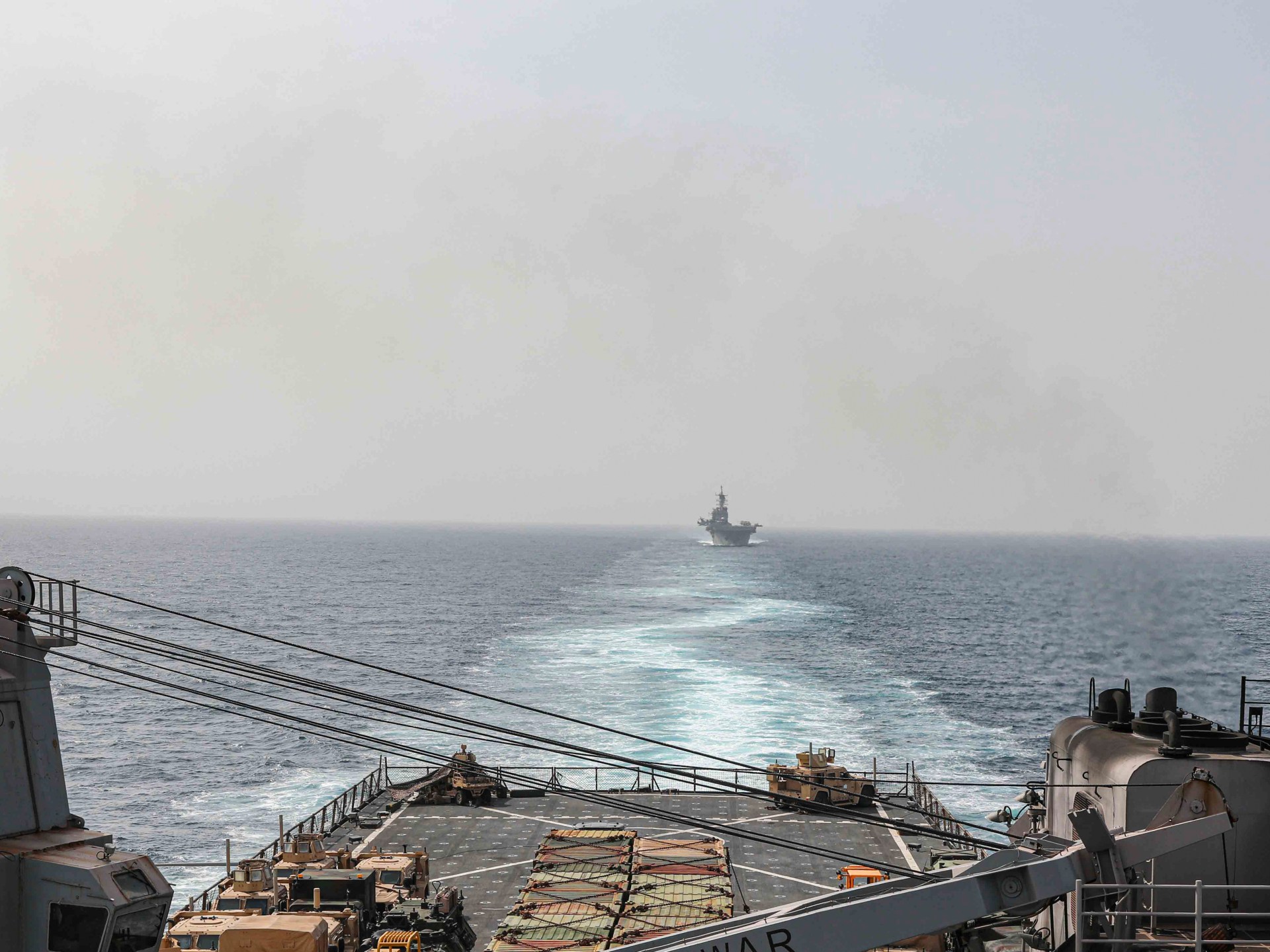
EXPLAINERIf the fighting in Yemen expands, and the Houthis try to block the Bab al-Mandeb, the world economy would face a new shock.The amphibious dock landing ship USS Carter Hall and amphibious assault ship USS Bataan transit the Bab al-Mandeb Strait on August 9, 2023 [Mass Communications Spc. 2nd Class Moises Sandoval/US Navy via AP]Published On 14 Jul 2026A sudden military escalation in Yemen has shattered a fragile, informal four-year truce, threatening to expand an ongoing geopolitical conflict into the Red Sea and sever one of the world’s most vital energy arteries.Following days of heightened rhetoric, Yemen’s internationally recognised government bombed the runway at Sanaa International Airport on Monday to prevent an Iranian aircraft from landing. In swift retaliation, Houthi rebels fired ballistic missiles towards southern Saudi Arabia, accusing Riyadh of being behind the attack on the airport — and declaring that the era of de-escalation with Yemen’s larger neighbour was officially over.While the immediate violence centres on the airport dispute, analysts warn that the true danger lies in how this localised flare-up could spill over into the Bab al-Mandeb Strait, if it expands.The Sanaa airport flashpointThe trigger for the latest crisis highlights the deep regional fault lines running through Yemen. The Yemeni government, backed by a Saudi-led coalition, justified its strike on the airport by claiming the Iranian flight was carrying military experts, drone technology, and communication equipment.Houthi officials on the other hand have insisted the aircraft was transporting over 200 stranded medical patients alongside a delegation returning from the funeral of the late Iranian Supreme Leader Ayatollah Ali Khamenei in Tehran. The Houthis ultimately diverted the flight to Hodeidah and responded by launching ballistic missiles at Saudi Arabia’s Abha International Airport, which the Saudi-led coalition said it intercepted.A two-front maritime chokepointThe resurgence of violence in Yemen comes at a precarious time for global trade. With Iran effectively closing the Strait of Hormuz again amid its ongoing war with the United States and Israel, the Bab al-Mandeb has become a critical pressure point.“The Yemen situation, or the entire Bab al-Mandeb region, has been on a powder keg from the first day of the war,” said Ibrahim Fraihat, a professor of international conflict resolution at the Doha Institute for Graduate Studies, to Al Jazeera, noting that the “spillover” of the conflict into surrounding areas was inevitable.For Tehran, shifting focus to the Red Sea offers a strategic counterweight to Washington’s naval blockade in the Gulf. Ali Akbar Velayati, a senior adviser to Iran’s supreme leader, has warned more than once that the “axis of resistance” — an Iran-backed coalition that includes the Houthis — has the capability to block both waterways.Mohammad Cherkaoui, a professor of international conflict resolution, warned that as American pressure and the naval blockade increase on the Strait of Hormuz, Iran might seek to find a new outlet through its regional allies. “If the Bab al-Mandeb crisis erupts in parallel with the Hormuz crisis, we will face a pincer movement that blows away the stability and security of the Gulf,” Cherkaoui told Al Jazeera.This strategy appears to be calculated. Mohammad Saleh Sedghian, director of the Arab Centre for Iranian Studies, pointed to recent remarks by Esmail Qaani, the commander of Iran’s Quds Force, who spoke of forming “a belt between the Strait of Hormuz and the Bab al-Mandeb” to protect the axis of resistance.The ‘Gate of Tears’Historically known in Arabic as the “Gate of Tears” due to the historical dangers of navigating its narrow waters, the Bab al-Mandeb Strait is a 29km (18-mile) bottleneck connecting the Red Sea to the Gulf of Aden and the Indian Ocean.Roughly 12 percent of global trade passes through it daily, including heavily laden container ships travelling between Asia and Europe.Crucially, the strait is a massive energy corridor. In 2024, oil trade flows through the Bab al-Mandeb averaged 4.0 million barrels per day. It serves as an essential route for moving crude oil, refined petroleum products, and liquefied natural gas (LNG) towards European and North American markets.The closure scenarioWith traffic barely passing through the Strait of Hormuz amid the recent escalation in fighting between the US and Iran, a closure of the Bab al-Mandeb would be catastrophic for global energy markets.Iran has declared the Strait of Hormuz closed, and US President Donald Trump has reimposed a naval blockade on all Iran-linked ships trying to pass through that waterway.If the Bab al-Mandeb and the Strait of Hormuz were shut simultaneously, approximately 25 percent of the world’s total oil and gas supply would be blocked. Ships would be forced to reroute around the southern tip of Africa via the Cape of Good Hope, adding 10 to 14 days to delivery schedules. This detour would send shipping and insurance costs skyrocketing, triggering a severe global economic shock.“If the Houthis decide to respond, believing Saudi Arabia started this… it will lead to greater escalation, and I am even more concerned about maritime navigation in the Red Sea,” Bill Putnam, former commander of the US Military Intelligence Readiness Command, told Al Jazeera.Threatening the Saudi bypassA closure of the Bab al-Mandeb would also neutralise a major strategic advantage held by Saudi Arabia.Unlike its Gulf neighbours—such as Kuwait, Bahrain, Qatar and the UAE, whose energy exports are largely trapped by the closure of the Strait of Hormuz—Saudi Arabia has to an extent successfully circumvented the blockade using its East-West Pipeline.The 1,200km (745-mile) pipeline, operated by Saudi Aramco, links the Abqaiq oil facilities in the east to the port city of Yanbu on the Red Sea. Recently restored to its full capacity of 7 million barrels per day following attacks, this pipeline has allowed Riyadh to safely export massive volumes of crude away from the contested waters of the Gulf.A partial view of Saudi Arabia’s Abqaiq oil processing plant on September 20, 2019 Fayez Nureldine /AFP]However, exporting from Yanbu relies entirely on the Bab al-Mandeb remaining open for ships travelling south to Asian markets. If Houthi forces follow through on their threats and lock down the Red Sea chokepoint, Saudi Arabia’s successful bypass would be rendered useless, trapping its oil alongside that of its neighbours and plunging the global economy deeper into crisis.
SRCAl Jazeera
LANGEN
LEANCenter
WORDS1 022
ENT12
TUE · 2026-07-14 · 11:22 GMTBRIEF NSR-2026-0714-92894
NSR-2026-0714-92894News Report·EN·Economic Impact
How new Yemen tensions could complicate the global energy crisis
Recent military escalation in Yemen has broken a four-year truce, with the Yemeni government bombing Sanaa International Airport and Houthi rebels retaliating with missiles towards Saudi Arabia. Analysts warn this could spill over into the Bab al-Mandeb Strait, a vital global energy artery.
Mohammad MansourAl JazeeraFiled 2026-07-14 · 11:22 GMTLean · CenterRead · 5 min
Al JazeeraFIG 01
Reading time
5min
Word count
1 022words
Sources cited
3cited
Entities identified
12entities
Quality score
100%
§ 01
Briefing Summary
AI-generatedNEWSAR · AI
Recent military escalation in Yemen has broken a four-year truce, with the Yemeni government bombing Sanaa International Airport and Houthi rebels retaliating with missiles towards Saudi Arabia. Analysts warn this could spill over into the Bab al-Mandeb Strait, a vital global energy artery. The strait, connecting the Red Sea to the Indian Ocean, sees 12% of global trade and approximately 4 million barrels of oil daily. If the Bab al-Mandeb were blocked, alongside the Strait of Hormuz which Iran has effectively closed, around 25% of the world's oil and gas supply would be disrupted, forcing lengthy reroutes. This situation is seen as a strategic move by Iran and its allies to counter US naval blockades.
Confidence 0.90Sources 3Claims 5Entities 12
§ 02
Article analysis
Model · rule-basedFraming
Economic Impact
Conflict
Tone
Mixed Tone
AI-assessed
CalmNeutralAlarmist
Factuality
0.60 / 1.00
Mixed
LowHigh
Sources cited
3
Well sourced
FewMany
§ 03
Key claims
5 extracted01
The Bab al-Mandeb Strait has become a critical pressure point for global trade, especially with the Strait of Hormuz effectively closed.
factual
Confidence
0.90
02
A military escalation in Yemen threatens to expand into the Red Sea and sever a vital energy artery.
factual
Confidence
0.90
03
Houthi rebels fired ballistic missiles towards southern Saudi Arabia in retaliation, accusing Riyadh of the airport attack.
factualHouthi rebels
Confidence
0.80
04
The Yemeni government bombed Sanaa International Airport to prevent an Iranian aircraft from landing, claiming it carried military experts and drone technology.
factualYemeni government
Confidence
0.80
05
The 'axis of resistance' has the capability to block both the Strait of Hormuz and the Bab al-Mandeb Strait.
quoteAli Akbar Velayati
Confidence
0.70
§ 04
Full report
5 min read · 1 022 words§ 05
Entities
12 identifiedKey playerOppositionContextPositiveNeutralNegative
Locations9
§ 06
Keywords & salience
9 termsyemen tensions
1.00
global energy crisis
0.90
bab al-mandeb strait
0.90
houthi rebels
0.80
geopolitical conflict
0.70
maritime chokepoint
0.60
sanaa airport
0.50
saudi-led coalition
0.50
strait of hormuz
0.40
§ 07
Topic connections
Interactive graph Network visualization showing 51 related topics
View Full Graph Person Organization Location Event|Click node to navigate|Edge numbers = shared articles