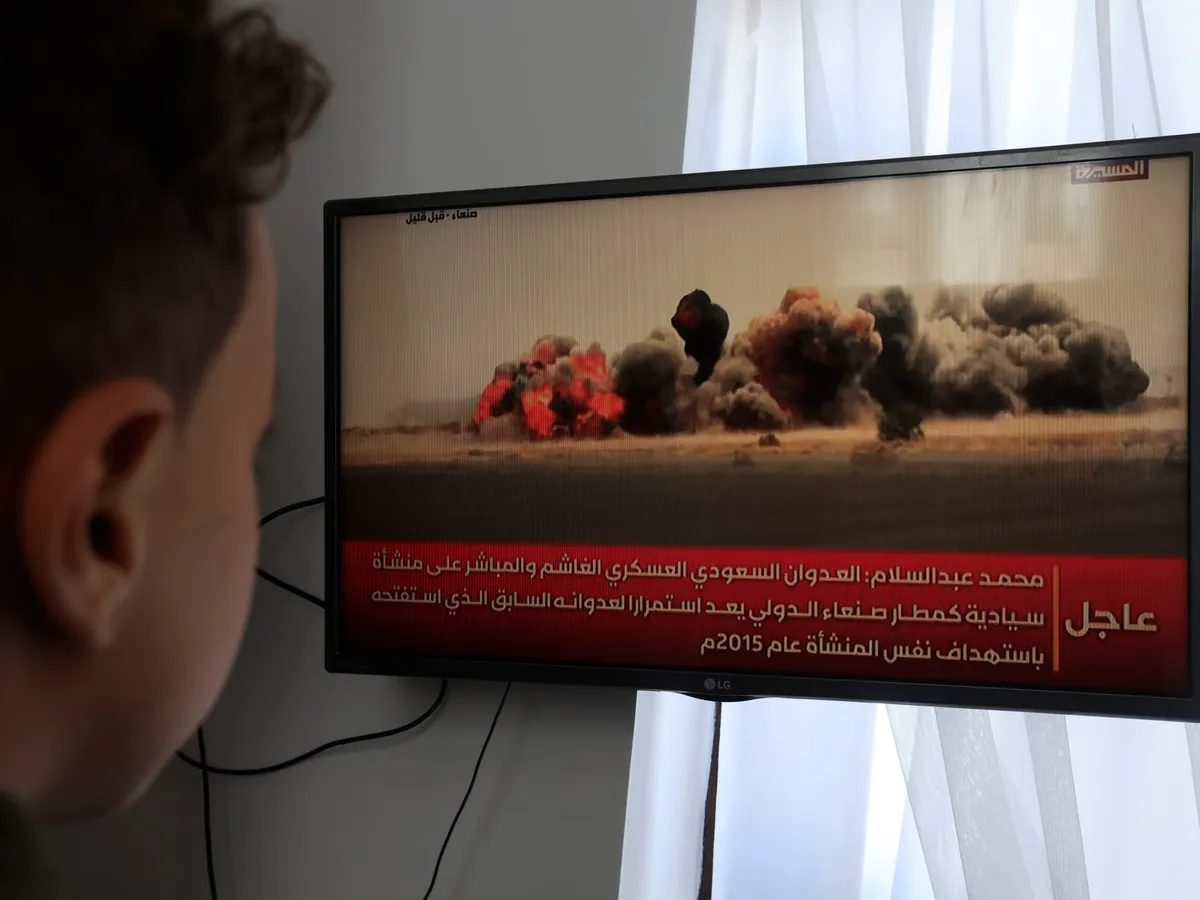
Mobilisation of fighters and attacks signal the collapse of Yemen’s fragile peace, with regional implications looming.A person watches a TV broadcast on air strikes hitting Sanaa airport, in Sanaa, Yemen, July 13, 2026 [Yahya Arhab/EPA]Published On 14 Jul 2026Sanaa, Yemen – Both Yemen’s internationally recognised government and the Houthi rebel group began mobilising fighters in late June. Then, on July 3, the first publicly announced flight between Tehran and Sanaa for more than a decade landed in the Houthi-controlled Yemeni capital, creating new tensions. Fighting during the next day between the two sides in western Yemen’s Hodeidah governorate killed dozens, the worst violence in four years.And then, on Monday, the attempted landing of another flight from Tehran in Sanaa led to the bombing of the airport’s runway by the Yemeni government, and the firing of Houthi ballistic missiles at Saudi Arabia.Recommended Stories list of 3 itemslist 1 of 3Leading Houthi threatens ‘siege’ on Saudi Arabia after Yemen airport attacklist 2 of 3Iran lawmakers present Hormuz management bill as US war heats uplist 3 of 3How new Yemen tensions could complicate the global energy crisisend of listYemen’s Defence Minister Taher al-Aqili said that the government’s “patience has run out”. Houthi military spokesperson Yahya Saree said that the “de-escalation phase” of Yemen’s war was over.Yemen’s war, now more than 10 years old, had been cold since a truce was agreed in 2022. But, with the Houthis’ main ally Iran fighting the US and bombing the Gulf, the conflict in the Middle East’s poorest country may be about to reignite, plunging Yemen back into large-scale war.Regional threatsThe Houthis have blamed Saudi Arabia for the attack on Sanaa airport, despite the Yemeni government’s claim that it was responsible.Salah Ali Salah, a researcher at the Sanaa Center for Strategic Studies, described the recent rhetoric from the Houthis as “striking”, and pointed out that the consequences of their actions will not be limited to the front lines in Yemen.“The Houthis have openly rejected the continuation of the ‘no war, no peace’ status quo while simultaneously expanding campaigns to mobilise fighters and the broader population,” Salah told Al Jazeera. “This rhetoric is not solely intended to augment internal mobilisation or contain the growing social and economic pressures that have grown during prolonged periods of relative calm on the front lines. Rather, it appears to be preparing the political and propaganda landscape for another phase of war that could have repercussions on the region.”The war between Iran and the US has demonstrated the problems spillover from regional conflicts can have on Gulf security. And as Iran attacks the Gulf from the east, the fear is that the Houthis will attack from the south – as they have done in the past, during the height of the Yemen war.“The Houthis possess both the geographic position and the military capabilities to make them one of the most consequential actors capable of exerting pressure on Gulf states or disrupting maritime traffic in the Red Sea,” Salah said.But that doesn’t mean it is certain, and there would be consequences for the Houthis. They have already come under heavy attack over the past few years from Israel, the United Kingdom, and the United States, after it launched strikes disrupting shipping in the Red Sea following the beginning of Israel’s genocidal war on Gaza.Those attacks have been punishing for the Houthis, and for the Yemenis in the areas of northwest Yemen under their control. They would have to justify any move towards war, or risk unrest from the populace.“From this perspective, the Houthi renewed focus on Saudi Arabia [and] the blockade [of Sanaa Airport] … can be interpreted as an attempt to reconstruct a local narrative that portrays any future escalation with the Gulf as an extension of the Yemeni conflict, rather than simply a reflection of regional tensions or the interests of the Houthis’ allies [Iran and Hezbollah],” Salah said.With the continuing mobilisation and pro-war discourse, Salah said that the Houthis are rearranging their priorities, working to redefine the “next enemy” and preparing public opinion for the possibility of a new escalation.Truce to war?While the years since 2022 have brought relative calm to areas under Houthi control, and even the opening of Sanaa International Airport to civilian travel for a period, the lack of conflict with the government and the Saudi-led coalition has made it more difficult for the Houthis to blame external parties for the economic difficulties areas under the group’s control are going through.Meanwhile, the Yemeni government – with the backing of Saudi Arabia – has been able to consolidate some control in eastern and southern Yemen after its opponents within the anti-Houthi coalition, the separatist Southern Transitional Council, were defeated at the end of last year.That has allowed the Yemeni government to turn its attention towards the Houthis. The beginning of the US war with Iran led to predictions of support from Washington for a government advance on the Houthis in Yemen, but a Gulf desire to ease tensions and de-escalate with Iran made that less likely.Still, the Houthis and the Yemeni government may decide that an eventual return to war is inevitable, and each side may prefer to start such a conflict at a time of their choosing, rather than be forced into it.Years of faltering diplomatic negotiations between the Houthis and the Yemeni government, as well as Saudi Arabia, have meant that a coming military battle cannot be ruled out, said Yemeni analyst Adel Dashela.“Should the Houthi group continue to reject the peace proposals, the military option remains on the table, though its implementation is largely contingent on the Saudi position,” Dashela told Al Jazeera.Four years from the truce that paused Yemen’s war, trust has not been built. Deals have been on the table, with a United Nations roadmap in late 2023 including funding for all public sector salaries, an end to restrictions on roads and airports, and the resumption of oil exports – all eventually leading to a political process that would end the war.No deal was ever struck. And now all sides seem to be escalating their rhetoric, as well as their actions.“Indications suggest that Riyadh is becoming less tolerant of the Houthis’ stalling tactics, which makes a renewed battle a possible scenario unless a political breakthrough occurs,” Dashela said.The Yemeni government has also sought to emphasise the Houthis’ links to Iran, with military spokesperson Abdo Majali saying that the July 3 flight from Iran to Sanaa was evidence that Tehran continues to use the Houthis as a “tool to implement its expansionist project in the region and undermine the sovereignty of the Yemeni state”.Meanwhile, a leading Houthi official, Mohammed al-Bukhaiti, threatened Saudi Arabia in comments made to Al Jazeera following the strikes on Sanaa airport. “Their willingness to attack Sanaa airport to prevent flights from arriving or departing gives Yemen the right to strike their airports and to impose on them a siege just as they have done to us,” al-Bukhaiti said.Frustration with deadlockIn Sanaa, the Houthis have been working to mobilise thousands of fighters for whatever battles may be about to take place.Ali Mohammed, a member of the Houthis’ popular committees, said thousands of fighters were ready to take part should battles erupt.“These fighters are true believers in the [Houthi] leadership, and they will implement any fighting instructions they receive,” Mohammed said.Recently recruited fighters, he said, have received training on fighting on the front lines, and “they will be an indispensable backup to the [main Houthi] armed forces”.
SRCAl Jazeera
LANGEN
LEANCenter
WORDS1 244
ENT12
TUE · 2026-07-14 · 20:17 GMTBRIEF NSR-2026-0714-93059
NSR-2026-0714-93059Analysis·EN·Conflict
Why Yemen’s long ‘no war, no peace’ deadlock may be ending
Yemen's fragile peace is collapsing as both the internationally recognized government and Houthi rebels mobilize fighters. Tensions escalated on July 3 with the first flight from Tehran to Houthi-controlled Sanaa in over a decade, followed by clashes in Hodeidah governorate.
Al Jazeera StaffAl JazeeraFiled 2026-07-14 · 20:17 GMTLean · CenterRead · 5 min
Al JazeeraFIG 01
Reading time
5min
Word count
1 244words
Sources cited
2cited
Entities identified
12entities
Quality score
100%
§ 01
Briefing Summary
AI-generatedNEWSAR · AI
Yemen's fragile peace is collapsing as both the internationally recognized government and Houthi rebels mobilize fighters. Tensions escalated on July 3 with the first flight from Tehran to Houthi-controlled Sanaa in over a decade, followed by clashes in Hodeidah governorate. The Yemeni government then bombed Sanaa airport's runway on Monday after an attempted Tehran flight, prompting Houthi ballistic missile fire at Saudi Arabia. Both sides have declared the de-escalation phase over. This renewed fighting, occurring amidst regional tensions between Iran and the US, could reignite Yemen's decade-long conflict with significant implications for regional security and maritime traffic. The Houthis appear to be preparing for a new phase of war, potentially to reconstruct a local narrative and address internal economic pressures.
Confidence 0.90Sources 2Claims 5Entities 12
§ 02
Article analysis
Model · rule-basedFraming
Conflict
Diplomatic
Tone
Mixed Tone
AI-assessed
CalmNeutralAlarmist
Factuality
0.60 / 1.00
Mixed
LowHigh
Sources cited
2
Limited
FewMany
§ 03
Key claims
5 extracted01
The Houthis have openly rejected the continuation of the ‘no war, no peace’ status quo while simultaneously expanding campaigns to mobilise fighters.
quoteSalah Ali Salah
Confidence
0.90
02
On July 3, the first publicly announced flight between Tehran and Sanaa for more than a decade landed in Sanaa.
factual
Confidence
0.90
03
Both Yemen’s internationally recognised government and the Houthi rebel group began mobilising fighters in late June.
factual
Confidence
0.90
04
The attempted landing of another flight from Tehran in Sanaa on Monday led to the bombing of the airport’s runway by the Yemeni government.
factual
Confidence
0.80
05
Fighting in Hodeidah governorate on July 4 killed dozens, the worst violence in four years.
factual
Confidence
0.80
§ 04
Full report
5 min read · 1 244 words§ 05
Entities
12 identifiedKey playerOppositionContextPositiveNeutralNegative
Organizations2
Locations6
§ 06
Keywords & salience
10 termsyemen conflict
1.00
houthi rebels
0.90
fragile peace
0.80
regional implications
0.70
iran
0.60
sanaa airport
0.60
saudi arabia
0.50
mobilisation of fighters
0.50
ballistic missiles
0.40
us
0.40
§ 07
Topic connections
Interactive graph Network visualization showing 51 related topics
View Full Graph Person Organization Location Event|Click node to navigate|Edge numbers = shared articles