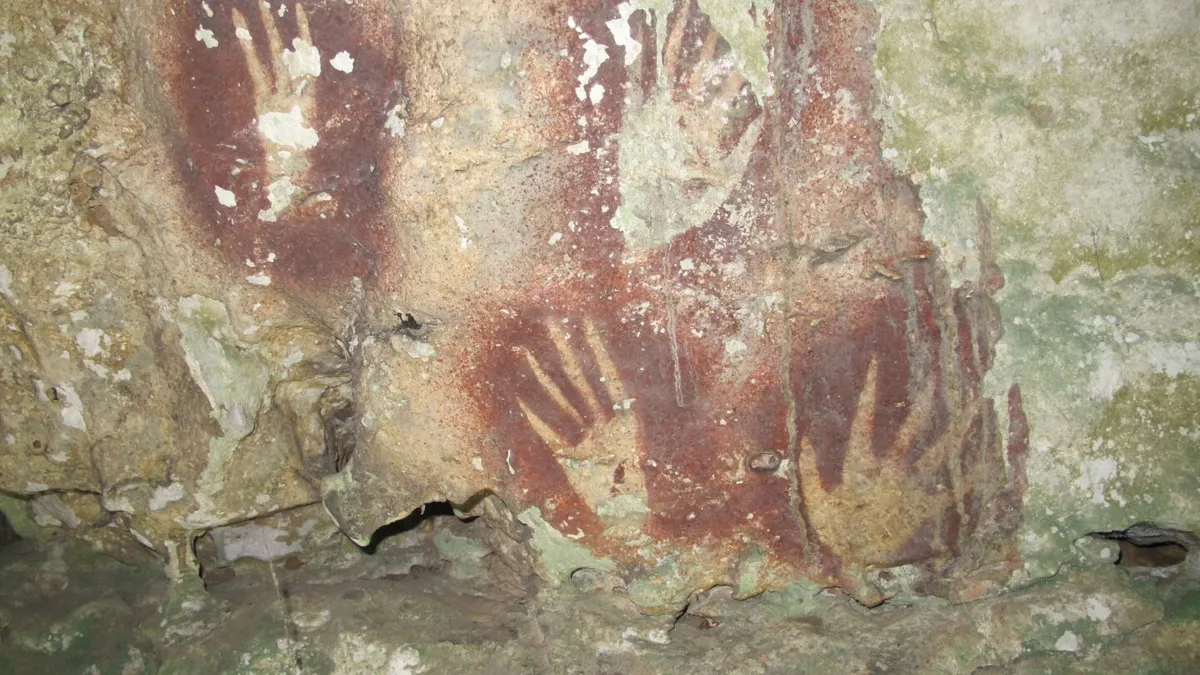
Indonesian handprints are the oldest cave art found yet 1 of 4 | This undated image provided by Maxime Aubert shows handprints with sharpened fingertips in the Maros region of Sulawesi, Indonesia. (Ahdi Agus Oktaviana/Maxime Aubert via AP) 2 of 4 | This image provided by Maxime Aubert shows cave drawings in Sulawesi, Indonesia of a human figure and a bird with a faded handprint in between them. (Maxime Aubert via AP) 3 of 4 | This image provided by Maxime Aubert shows scientist Adhi Agus Oktaviana studying handprints on the walls of a cave in Sulawesi, Indonesia. (Maxime Aubert via AP) 4 of 4 | This image provided by Maxime Aubert shows scientist Shinatria Adhityatama studying cave art found in Sulawesi, Indonesia. (Maxime Aubert via AP) 1 of 4 This undated image provided by Maxime Aubert shows handprints with sharpened fingertips in the Maros region of Sulawesi, Indonesia. (Ahdi Agus Oktaviana/Maxime Aubert via AP) Add AP News on Google Add AP News as your preferred source to see more of our stories on Google. 2 of 4 This image provided by Maxime Aubert shows cave drawings in Sulawesi, Indonesia of a human figure and a bird with a faded handprint in between them. (Maxime Aubert via AP) Add AP News on Google Add AP News as your preferred source to see more of our stories on Google. 3 of 4 This image provided by Maxime Aubert shows scientist Adhi Agus Oktaviana studying handprints on the walls of a cave in Sulawesi, Indonesia. (Maxime Aubert via AP) Add AP News on Google Add AP News as your preferred source to see more of our stories on Google. 4 of 4 This image provided by Maxime Aubert shows scientist Shinatria Adhityatama studying cave art found in Sulawesi, Indonesia. (Maxime Aubert via AP) Add AP News on Google Add AP News as your preferred source to see more of our stories on Google. Updated [hour]:[minute] [AMPM] [timezone], [monthFull] [day], [year] NEW YORK (AP) — Handprints on cave walls in a largely unexplored area of Indonesia may be the oldest rock art studied so far, dating back to at least 67,800 years ago.The tan-colored prints analyzed by Indonesian and Australian researchers on the island of Sulawesi were made by blowing pigment over hands placed against the cave walls, leaving an outline. Some of the fingertips were also tweaked to look more pointed. This prehistoric art form suggests the Indonesian island was home to a flourishing artistic culture. To figure out how old the paintings were, researchers dated mineral crusts that had formed on top of the art. Upon seeing the new study, independent paleoanthropologist Genevieve von Petzinger said she “let out a little squeal of joy.” “It fits everything I’d been thinking,” she said.Indonesia is known to host some of the world’s earliest cave drawings, and scientists have analyzed countless examples of ancient art across the globe — including simple marks on bones and stones that go back hundreds of thousands of years. Cross-hatched markings on a piece of rock in South Africa have been dated to about 73,000 years ago. The new art from southeastern Sulawesi is the oldest to be found on cave walls. The stencils also represent a more complex tradition of rock art that could have been a shared cultural practice, said study author Maxime Aubert with Griffith University, who published the study Wednesday in the journal Nature. Scientists are eager to understand when early humans learned to make art, moving from dots and lines to more meaningful representations of themselves and the world around them. These cave drawings help firm up a timeline for the dawn of human creativity. Stay up to date with the news and the best of AP by following our WhatsApp channel. Follow on It’s not yet clear whose hands made the prints. They could be from an ancient human group called Denisovans who lived in the area and may have interacted with our Homo sapiens ancestors before eventually going extinct. Or they may belong to modern humans venturing away from Africa, who could have wandered through the Middle East and Australia around this time. Fine details on the cave art, including the intentionally modified fingertips, point to a human hand. Other drawings discovered in the same area of the island, including a human figure, a bird and horselike animals, were found to be created much more recently, some of them about 4,000 years ago. There’s likely more art to be found on nearby islands that could be even older than the handprints. Future studies may help scientists understand how these artistic traditions spread across the globe and how they’re woven into the fabric of humanity’s early days.“For us, this discovery is not the end of the story,” Aubert said in an email. “It is an invitation to keep looking.”The Associated Press Health and Science Department receives support from the Howard Hughes Medical Institute’s Department of Science Education and the Robert Wood Johnson Foundation. The AP is solely responsible for all content.
SRCAssociated Press (AP)
LANGEN
LEANCenter
WORDS838
ENT5
WED · 2026-01-21 · 16:23 GMTBRIEF NSR-2026-0121-9418
NSR-2026-0121-9418News Report·EN·Human Interest
Indonesian handprints are the oldest cave art found yet
Cave paintings discovered in Sulawesi, Indonesia, have been identified as the oldest known rock art. The handprints, analyzed by Indonesian and Australian researchers, are estimated to be at least 67,800 years old.
By
ADITHI RAMAKRISHNANAssociated Press (AP)Filed 2026-01-21 · 16:23 GMTLean · CenterRead · 4 min
Associated Press (AP)FIG 01
Reading time
4min
Word count
838words
Sources cited
1cited
Entities identified
5entities
Quality score
100%
§ 01
Briefing Summary
AI-generatedNEWSAR · AI
Cave paintings discovered in Sulawesi, Indonesia, have been identified as the oldest known rock art. The handprints, analyzed by Indonesian and Australian researchers, are estimated to be at least 67,800 years old. The art was created by blowing pigment around hands pressed against cave walls, leaving a hand outline. Researchers dated mineral crusts that had formed on top of the paintings to determine their age. The discovery suggests that a sophisticated artistic culture existed on the Indonesian island during prehistoric times. Scientists Adhi Agus Oktaviana and Shinatria Adhityatama are studying the cave art.
Confidence 0.90Sources 1Claims 5Entities 5
§ 02
Article analysis
Model · rule-basedFraming
Human Interest
Technology
Tone
Measured
AI-assessed
CalmNeutralAlarmist
Factuality
0.90 / 1.00
Factual
LowHigh
Sources cited
1
Limited
FewMany
§ 03
Key claims
5 extracted01
Upon seeing the new study, independent paleoanthropologist Genevieve von Petzinger said she “let out a little squeal of joy.”
quoteGenevieve von Petzinger
Confidence
1.00
02
The tan-colored prints were made by blowing pigment over hands placed against the cave walls.
factual
Confidence
1.00
03
Indonesia is known to host some of the world’s earliest cave drawings.
factual
Confidence
0.90
04
Handprints on cave walls in Indonesia may be the oldest rock art studied so far, dating back to at least 67,800 years ago.
factual
Confidence
0.90
05
This prehistoric art form suggests the Indonesian island was home to a flourishing artistic culture.
factual
Confidence
0.80
§ 04
Full report
4 min read · 838 words§ 05
Entities
5 identifiedKey playerOppositionContextPositiveNeutralNegative
People1
Organizations1
§ 06
Keywords & salience
8 termscave art
1.00
handprints
0.90
indonesia
0.80
sulawesi
0.70
prehistoric art
0.60
rock art
0.60
dating
0.50
pigment
0.40
§ 07
Topic connections
Interactive graph Network visualization showing 51 related topics
View Full Graph Person Organization Location Event|Click node to navigate|Edge numbers = shared articles