EXPLAINERSaudi Arabia has condemned the Houthi naval blockade that could impact oil flow to importers of Saudi oil.Published On 21 Jul 2026Saudi Arabia on Monday condemned allegations by Yemen’s Iran-aligned Houthis that Riyadh was imposing a siege on the Yemeni people, after the group announced it would impose a maritime blockade on Saudi Arabia.Amid the disruption in shipping through the Strait of Hormuz during the US-Israel war on Iran, Saudi Arabia was attempting to facilitate oil flow through alternative routes through the Red Sea and the Bab al-Mandeb Strait. Now that route is under threat from the Houthis.The Saudi Foreign Ministry said in a statement that it would take “all necessary measures” to protect its ships.The Houthis have a track record of disrupting shipping traffic in the Red Sea. Here is a closer look at the blockade and what impact it might have beyond Saudi Arabia.What’s the latest on the blockade?The Houthis said on Monday that they would impose a naval blockade on Saudi Arabia, opening a potential new front against the US in its war with Iran and raising the threat to global energy supplies and trade beyond the Gulf.In their statement, the Houthis said the declaration of the maritime embargo was “based on the equation of ‘an eye for an eye'” and affirmed “the right of our great people to respond to the blockade with a blockade” and to “all escalation with escalation”.The Houthis also expressed “complete readiness for all options” and warned that “any foolish” Saudi act would be met with a “comprehensive and decisive” response.“We call upon the people of our great nation to continue the general mobilisation and general call to arms, and to be fully prepared for all scenarios and developments and to support the fronts with fighters,” the group said.It was not immediately clear how the Houthis would implement the maritime blockade or whether it could signal a return to attacks on international shipping off the Yemeni coast.The Houthis disrupted global commerce when they began attacking ships around the Bab al-Mandeb Strait following the launch of Israel’s genocidal war on Gaza in October 2023. The attacks ended with the announcement of a “ceasefire” in Gaza in October 2025.The Bab al-Mandeb chokepoint connecting the Red Sea to the Gulf of Aden is one of the world’s most important shipping routes, including for oil exports worldwide.Between Yemen to the northeast and Djibouti and Eritrea in the Horn of Africa to the southwest, the strait is just 29km (18 miles) wide at its narrowest point, limiting traffic to two channels for inbound and outbound vessels using the Suez Canal.In 2024, about 4.1 billion barrels of crude oil and refined petroleum products passed through the strait – about five percent of the global total.With the Strait of Hormuz effectively closed since Israel and the United States launched their war on Iran in late February, shutting down Bab al-Mandeb as well could block 25 percent of the world’s oil and gas supply.What is the context?The Houthis, who seized Yemen’s capital, Sanaa, in 2014, accused Saudi leaders of imposing “an unjust and oppressive siege” for nearly 12 years, “plundering our resources and imposing a comprehensive blockade on our ports and airports by land, sea, and air”.Yemen has been mired in civil war for more than a decade since the Houthis seized the capital, prompting a Saudi-led military intervention in 2015 in support of the internationally recognised government.The conflict has since evolved into one of the world’s worst humanitarian crises, leaving the country divided between a Saudi-backed and internationally recognised government in Aden and a Houthi administration in Sanaa.Cargo ships and other vessels have regularly arrived at the port of Houthi-controlled Hodeidah, including in recent weeks, delivering food, fuel and other goods, according to shipping data.What’s the latest on the Saudi-Houthi spat?The announcement came days after the Houthis blamed Saudi Arabia for attacking Sanaa airport, despite Yemen’s internationally recognised government claiming responsibility, saying it was to prevent an Iranian plane from landing in the capital.In response, the Houthis fired ballistic missiles at Saudi Arabia’s Abha International Airport, which the Saudi-led coalition said it successfully intercepted. That followed fighting between Houthi and government forces in Hodeidah, threatening four years of precarious calm since the signing of a temporary truce.“The Houthis and the Saudis, unfortunately, have not been able to make their ceasefire hold. And it’s gone south pretty quickly. And obviously led to this, this blockade being announced,” Michael Stephens, a senior associate fellow at the Royal United Services Institute for Defence and Security Studies, told Al Jazeera.“But of course, it has to be seen within the context of everything that’s going on the other side of the Arabian Peninsula, and the war that has now restarted in the Gulf between Iran and the US.”How will this impact Saudi Arabia?The announcement is likely to further hamper Saudi Arabia’s crucial oil exports.The East-West Pipeline, also known as the Petroline, is operated by Saudi oil giant Aramco. Aramco is one of the world’s largest companies, with a market capitalisation exceeding $1.7 trillion and annual revenues of $480bn. The oil giant controls 12 percent of global oil production with a capacity of more than 12 million barrels per day (bpd).The 1,200km (745-mile) pipeline runs from the Abqaiq oil processing centre close to the Gulf in Saudi Arabia to the Yanbu port on the Red Sea on the other side of the country.From there, oil tankers ship the oil through Bab al-Mandeb to major Asian markets and elsewhere.Ship tracking data from Kpler and Signal Ocean showed that shipments from Yanbu averaged four million barrels per day in recent weeks, up from around 973,000 bpd a year earlier, according to Reuters.Total petroleum volumes transiting Bab al-Mandeb were 7.4 million bpd in June, or about 7 percent of global oil output, according to Kpler data. That is compared to 4.2 million bpd last year.How will the rest of the world be impacted?In 2024, Saudi Arabia exported $187bn of crude petroleum, making crude petroleum the country’s biggest export, according to the Observatory of Economic Complexity (OEC).In that year, China imported 25.6 percent of this crude petroleum, while South Korea imported 15.8 percent, Japan imported 15.4 percent, and India imported 10.5 percent.Since China and India are major buyers of Saudi crude, their refiners rely on steady Saudi volumes — all of which come through the Bab al-Mandeb. Disruptions mean higher import costs, greater reliance on spot cargoes, and potential pressure on domestic fuel prices and industry.India has also emerged as a key Asian supplier of refined petroleum products to Europe, so any sustained disruption to Saudi flows or Gulf shipping would likely push up the price of oil products exported to European markets.Stephens said the blockade would be “hugely harmful” to the oil economy.“Essentially, what you’re doing is you’re shutting off the vast majority of oil supply” from one of the world’s largest suppliers of crude in the world, he said. “And that’s going to have very deleterious effects on the oil market.”“If you’re [US President] Donald Trump and you want to see oil down at $70 a barrel, that is not going to happen,” Stephens added.Oil prices edged higher on Tuesday, with Brent crude futures at $89.70 a barrel by 09:50 GMT. Before the US-Israel war on Iran, Brent crude futures averaged around $70 per barrel. Following the outbreak of the conflict, prices peaked at $126 per barrel.
SRCAl Jazeera
LANGEN
LEANCenter
WORDS1 230
ENT12
TUE · 2026-07-21 · 14:37 GMTBRIEF NSR-2026-0721-94741
NSR-2026-0721-94741Analysis·EN·Economic Impact
Saudi condemns Houthi blockade: How will the rest of the world be impacted?
Saudi Arabia has condemned the Houthi declaration of a naval blockade against the kingdom, which threatens oil flow through the Bab al-Mandeb Strait. The Houthis stated the blockade is a response to Saudi actions, citing an "eye for an eye" equation.
Al Jazeera StaffAl JazeeraFiled 2026-07-21 · 14:37 GMTLean · CenterRead · 5 min
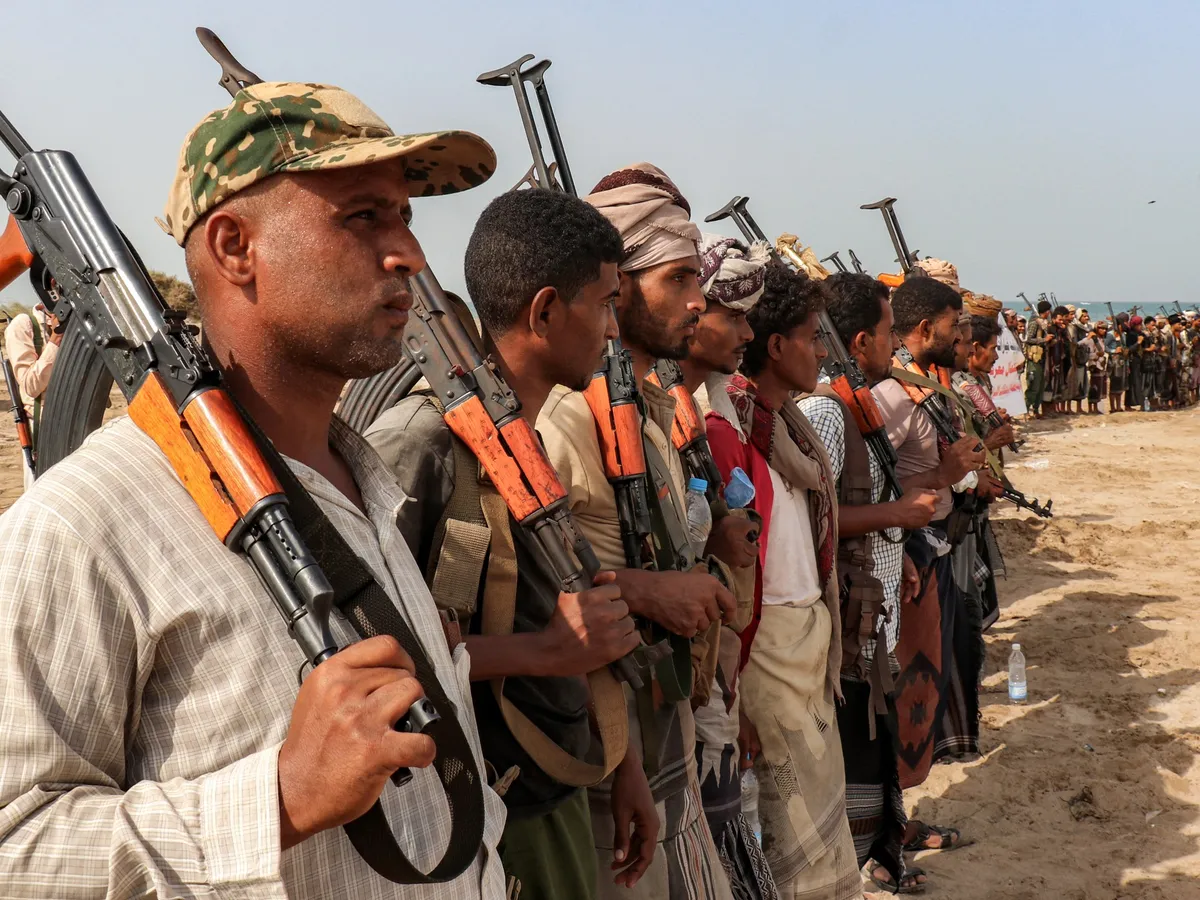
Al JazeeraFIG 01
Reading time
5min
Word count
1 230words
Sources cited
1cited
Entities identified
12entities
Quality score
100%
§ 01
Briefing Summary
AI-generatedNEWSAR · AI
Saudi Arabia has condemned the Houthi declaration of a naval blockade against the kingdom, which threatens oil flow through the Bab al-Mandeb Strait. The Houthis stated the blockade is a response to Saudi actions, citing an "eye for an eye" equation. This move opens a potential new front in regional conflicts and could significantly impact global energy supplies, as the Bab al-Mandeb Strait is a crucial shipping route for oil. The Houthis have previously disrupted shipping in the Red Sea. This escalation follows recent clashes between Houthi and Saudi-backed forces and accusations of attacks on Sanaa airport. The Houthis accuse Saudi Arabia of imposing a siege on Yemen.
Confidence 0.90Sources 1Claims 5Entities 12
§ 02
Article analysis
Model · rule-basedFraming
Economic Impact
Conflict
Tone
Mixed Tone
AI-assessed
CalmNeutralAlarmist
Factuality
0.60 / 1.00
Mixed
LowHigh
Sources cited
1
Limited
FewMany
§ 03
Key claims
5 extracted01
The Bab al-Mandeb chokepoint is one of the world’s most important shipping routes, including for oil exports worldwide.
factual
Confidence
0.95
02
In 2024, about 4.1 billion barrels of crude oil and refined petroleum products passed through the strait – about five percent of the global total.
statistic
Confidence
0.90
03
The Houthis announced they would impose a maritime blockade on Saudi Arabia.
factualHouthis
Confidence
0.90
04
Saudi Arabia condemned the Houthi naval blockade that could impact oil flow to importers of Saudi oil.
factualSaudi Arabia
Confidence
0.90
05
Shutting down Bab al-Mandeb as well could block 25 percent of the world’s oil and gas, with the Strait of Hormuz effectively closed.
prediction
Confidence
0.70
§ 04
Full report
5 min read · 1 230 words§ 05
Entities
12 identifiedKey playerOppositionContextPositiveNeutralNegative
Organizations1
Locations9
§ 06
Keywords & salience
10 termshouthi blockade
1.00
saudi arabia
0.90
bab al-mandeb strait
0.80
oil flow
0.70
maritime blockade
0.70
global energy supplies
0.60
red sea
0.50
shipping routes
0.50
iran
0.40
us-israel war
0.40
§ 07
Topic connections
Interactive graph Network visualization showing 51 related topics
View Full Graph Person Organization Location Event|Click node to navigate|Edge numbers = shared articles