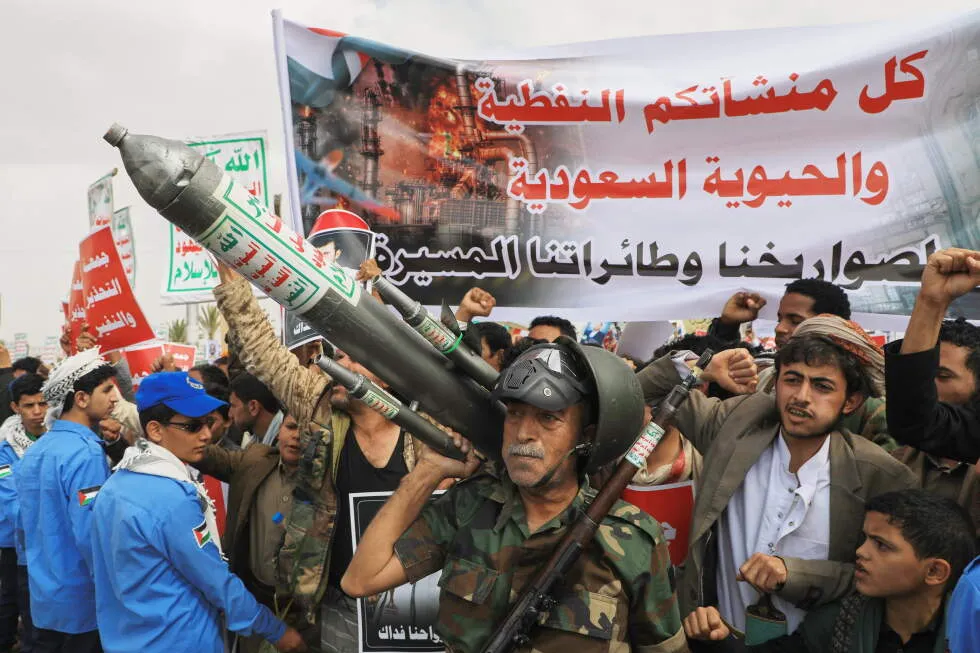
Houthi supporters hold a rally in Sanaa, Yemen, Friday, July 17, 2026, against the Saudi-led coalition. Banner in Arabic reads, “All Saudi oil facilities are targets to our missiles and drones.” (AP Photo/Osamah Abdulrahman) By MUNIR AHMED Updated 3:10 PM MESZ, July 22, 2026 Add AP News on Google Add AP News as your preferred source to see more of our stories on Google. Share Share Facebook Copy Link copied Print Email X LinkedIn Bluesky Flipboard Pinterest Reddit ISLAMABAD (AP) — The United States and Pakistan on Wednesday condemned Yemen’s Houthi rebels for threatening commercial shipping in the Red Sea after the group announced a naval blockade against Saudi Arabia earlier this week. U.S. Secretary of State Marco Rubio blamed Iran for the Houthi rebel group’s naval blockade against Saudi Arabia but hoped it could be de-escalated. The Houthis are armed and significantly influenced by Iran but are independent of Iran’s supreme leader, unlike the Lebanese militant Hezbollah group and several Iran-backed Iraqi militias. “Anything that restricts shipping through the Red Sea would be problematic for the same reasons that the Strait of Hormuz is problematic,” Rubio said on the sidelines of a regional summit in the Philippines. The U.S. is closely monitoring the situation, he said, and has contacted Saudi Arabia a number of times over the last week about the threats. The Strait of Hormuz, through which a fifth of the world’s oil passes in peacetime, has been fully or partially closed since the war in Iran started on Feb. 28 with U.S. and Israeli attacks. “It’s not a new threat, but it’s one that’s manifested itself in the past, but at the gist of that issue is the fact that, again, Iran is in the middle of it. Talking about the troublemaker in the region, it’s Iran,” he added. A new threat by Yemen’s Houthis could widen the Iran-war" class="entity-link entity-event" data-entity-id="38748" data-entity-type="event">Iran war and put another trade chokepoint at risk 5 MIN READ 61 A new threat by Yemen’s Houthis could widen the Iran-war" class="entity-link entity-event" data-entity-id="38748" data-entity-type="event">Iran war and put another trade chokepoint at risk 3 MIN READ Houthis say they attacked 2 Saudi oil tankers in the Red Sea as US carries out 12th night of strikes 3 MIN READ Meanwhile, Pakistan on Wednesday condemned the Houthi threats and said they violate established principles of international law. The Houthis opened a new front against Saudi Arabia by declaring a naval blockade of the kingdom, threatening the flow of global oil supplies and trade. With the Strait of Hormuz blocked, Saudi Arabia has relied on a pipeline to the Red Sea to get millions of barrels of oil out to market. Three Houthi officials said the group warned international shipping companies on Monday to avoid transiting through the Bab el-Mandeb Strait, the gateway to the Red Sea on the opposite side of the Arabian Peninsula from the Strait of Hormuz. The officials spoke on condition of anonymity because they were not authorized to speak to journalists. A news agency in Yemen run by the Houthis, SABA, said Tuesday that six ships in the Red Sea were forced to reroute after they received warnings from the rebel group. The Associated Press could not immediately confirm the claim but tracking data from MarineTraffic.com showed at least three tankers appeared to make U-turns on Tuesday. Pakistan’s Foreign Ministry on Wednesday warned that the actions “threaten regional security, undermine freedom of navigation, challenge the rules-based maritime order and jeopardize uninterrupted flow of global commerce.” The Foreign Ministry in Islamabad said Pakistan was “particularly concerned by reports of threats directed against vessels engaged in lawful commercial trade with the Kingdom.” The ministry warned that “any hostile act against Pakistani-flagged vessels or Pakistani maritime interests will be regarded as a grave threat to Pakistan’s national security and sovereign interests.” Pakistan and Saudi Arabia are longtime allies, and the kingdom is one of Pakistan’s largest oil suppliers. Last year, the two countries signed a mutual defense pact defining an attack on either nation as an attack on both. The agreement followed Israeli attacks on the neighboring Gulf state of Qatar. Pakistan has also repeatedly condemned Iranian attacks on Arab countries, including Saudi Arabia. Pakistan brokered an interim peace deal between the U.S. and Iran in June and is currently mediating between the two sides after they resumed attacks on each other earlier this month. Pakistan and Saudi Arabia have maintained close defense ties for decades, in part because of Islamabad’s longstanding commitment to help defend Islam’s holiest sites, Mecca and Medina, in the kingdom. Pakistani troops were first deployed to Saudi Arabia in the late 1960s amid concerns over the war in Yemen involving Egypt. Associated Press writers Fatma Khaled in Cairo and Michelle Price in Manila contributed to this report.
SRCAssociated Press (AP)
LANGEN
LEANCenter
WORDS791
ENT12
THU · 2026-07-23 · 11:23 GMTBRIEF NSR-2026-0723-95290
NSR-2026-0723-95290News Report·EN·Conflict
U.S. and Pakistan condemn Houthi Red Sea threats to shipping and Saudi Arabia
The United States and Pakistan have condemned Houthi rebels in Yemen for threatening commercial shipping in the Red Sea and announcing a naval blockade against Saudi Arabia. U.S.
Associated Press (AP)Filed 2026-07-23 · 11:23 GMTLean · CenterRead · 4 min
Associated Press (AP)FIG 01
Reading time
4min
Word count
791words
Sources cited
3cited
Entities identified
12entities
Quality score
100%
§ 01
Briefing Summary
AI-generatedNEWSAR · AI
The United States and Pakistan have condemned Houthi rebels in Yemen for threatening commercial shipping in the Red Sea and announcing a naval blockade against Saudi Arabia. U.S. Secretary of State Marco Rubio attributed the Houthi actions to Iran's influence and expressed concern about potential disruptions to shipping, comparing the situation to the Strait of Hormuz. Pakistan's Foreign Ministry stated the Houthi threats violate international law and jeopardize global commerce and regional security. Three Houthi officials reported warning international shipping companies to avoid the Bab el-Mandeb Strait, and Houthi media claimed several ships were rerouted. Pakistan emphasized that any hostile act against Pakistani maritime interests would be considered a grave threat to its national security.
Confidence 0.90Sources 3Claims 5Entities 12
§ 02
Article analysis
Model · rule-basedFraming
Conflict
Economic Impact
Tone
Measured
AI-assessed
CalmNeutralAlarmist
Factuality
0.70 / 1.00
Factual
LowHigh
Sources cited
3
Well sourced
FewMany
§ 03
Key claims
5 extracted01
Pakistan condemned the Houthi threats, stating they violate established principles of international law.
factualPakistan
Confidence
1.00
02
U.S. Secretary of State Marco Rubio blamed Iran for the Houthi rebel group’s naval blockade against Saudi Arabia.
quoteMarco Rubio
Confidence
1.00
03
The United States and Pakistan condemned Yemen's Houthi rebels for threatening commercial shipping in the Red Sea.
factualUnited States and Pakistan
Confidence
1.00
04
The Houthis announced a naval blockade against Saudi Arabia earlier this week.
factualHouthi rebels
Confidence
0.90
05
The Strait of Hormuz has been fully or partially closed since the war in Iran started on Feb. 28 with U.S. and Israeli attacks.
factual
Confidence
0.80
§ 04
Full report
4 min read · 791 words§ 05
Entities
12 identifiedKey playerOppositionContextPositiveNeutralNegative
People1
Organizations3
Locations7
§ 06
Keywords & salience
10 termsred sea shipping
1.00
houthi threats
1.00
saudi arabia
0.90
iran influence
0.80
strait of hormuz
0.70
naval blockade
0.70
global oil supplies
0.60
international law
0.50
us condemnation
0.50
pakistan condemnation
0.40
§ 07
Topic connections
Interactive graph Network visualization showing 13 related topics
View Full Graph Person Organization Location Event|Click node to navigate|Edge numbers = shared articles