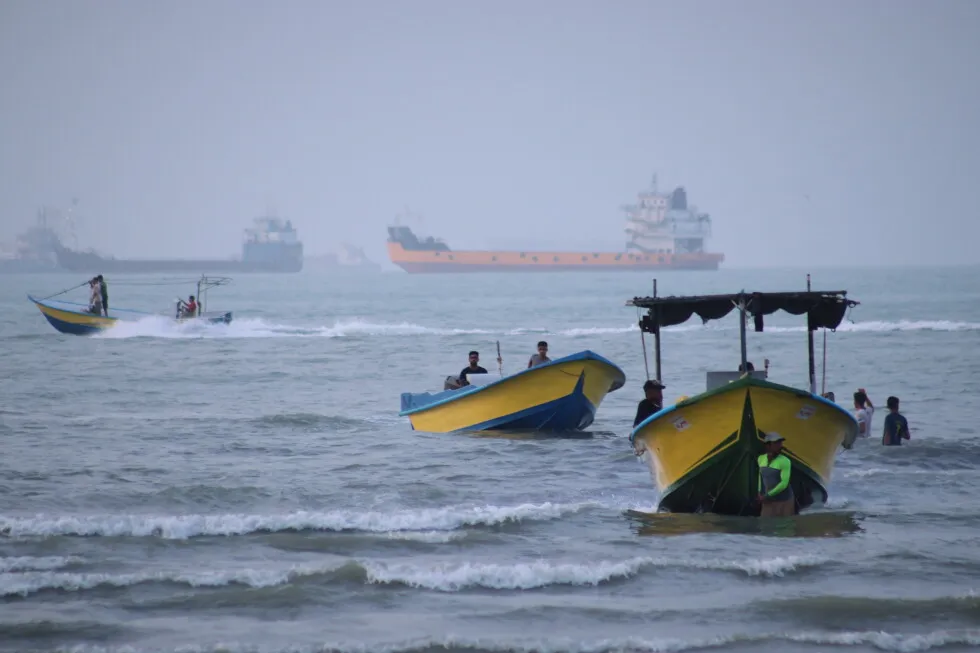
Jordan intercepts Iranian missiles as US and Saudi Arabia launch strikes against militias in Iraq 1 of 2 | Small boats line the shore as cargo ships and other commercial vessels appear anchored in the Strait of Hormuz off Bandar Abbas, Iran, Monday, July 27, 2026. (Razieh Poudat/ISNA via AP) 2 of 2 | Iranian pro-government demonstrators chant slogans in a gathering at a square in Tehran, Iran, Tuesday, July 28, 2026. (AP Photo/Vahid Salemi) 1 of 2 | Small boats line the shore as cargo ships and other commercial vessels appear anchored in the Strait of Hormuz off Bandar Abbas, Iran, Monday, July 27, 2026. (Razieh Poudat/ISNA via AP) 1 of 2 Small boats line the shore as cargo ships and other commercial vessels appear anchored in the Strait of Hormuz off Bandar Abbas, Iran, Monday, July 27, 2026. (Razieh Poudat/ISNA via AP) Add AP News on Google Add AP News as your preferred source to see more of our stories on Google. Share 2 of 2 | Iranian pro-government demonstrators chant slogans in a gathering at a square in Tehran, Iran, Tuesday, July 28, 2026. (AP Photo/Vahid Salemi) 2 of 2 Iranian pro-government demonstrators chant slogans in a gathering at a square in Tehran, Iran, Tuesday, July 28, 2026. (AP Photo/Vahid Salemi) Add AP News on Google Add AP News as your preferred source to see more of our stories on Google. Share Updated [hour]:[minute] [AMPM] [timezone], [monthFull] [day], [year] CAIRO (AP) — Jordan’s air defenses intercepted five missiles launched from Iran early Wednesday, the country’s military said, hours after the U.S. military said it had knocked down an Iranian missile barrage launched against American forces in the Middle East, shattering a brief pause in fighting.In a statement, the Jordanian military said the missiles had been “intercepted and destroyed.” Earlier, U.S. Central Command said they “remain vigilant and at a high state of readiness,” and that it worked with Saudi Arabia’s forces to strike sites in Iraq that Tehran-backed militias have used to launch attacks in recent days.In announcing the strikes in Iraq, the U.S. warned that further attacks on American troops or Saudi Arabia’s energy infrastructure risked additional action.The United States and Iran had experienced a period of calm, during which neither announced attacks for about three days following weeks of escalation over the strategic Strait of Hormuz, the Persian Gulf waterway and narrow chokepoint through which 20% of the world’s traded oil normally flows. The fighting flared at the end of a month packed with multiple pressure points on U.S. President Donald Trump. In recent weeks, four U.S. troops died during the fighting, while the Pentagon asked an increasingly skeptical Congress for money to cover the conflict’s ballooning costs.Iran launched its ballistic missile attack before American and Saudi forces carried out strikes in Iraq, according to a U.S. official, who stressed that the two attacks were not connected. The official spoke on condition of anonymity to detail sensitive military operations. 3 MIN READ 2 MIN READ “U.S. and Saudi fighter aircraft struck multiple terrorist logistics and weapons sites across eastern Iraq in a strong response to over 30 IRGC-directed aerial drone attacks in the last 72 hours,” U.S. Central Command said, using an acronym for Iran’s paramilitary Revolutionary Guard. It said the Revolutionary Guard “and its terrorist proxies must cease these attacks to avoid further U.S. military response.” The Saudi Defense Ministry acknowledged the strikes in a post on social media, warning that “the Kingdom emphasizes that it does not seek escalation but will respond to any aggression it faces.”Associated Press writer Konstantin Toropin in Washington contributed to this report.
SRCAssociated Press (AP)
LANGEN
LEANCenter
WORDS604
ENT12
WED · 2026-07-29 · 05:23 GMTBRIEF NSR-2026-0729-97019
NSR-2026-0729-97019News Report·EN·National Security
Jordan says it intercepted missiles launched from Iran
Jordan's air defenses intercepted five missiles launched from Iran early Wednesday, with the Jordanian military confirming they were destroyed. This occurred shortly after the U.S.
4 MIN READAssociated Press (AP)Filed 2026-07-29 · 05:23 GMTLean · CenterRead · 3 min
Associated Press (AP)FIG 01
Reading time
3min
Word count
604words
Sources cited
2cited
Entities identified
12entities
Quality score
100%
§ 01
Briefing Summary
AI-generatedNEWSAR · AI
Jordan's air defenses intercepted five missiles launched from Iran early Wednesday, with the Jordanian military confirming they were destroyed. This occurred shortly after the U.S. military announced it had downed an Iranian missile barrage targeting American forces in the Middle East, ending a brief lull in hostilities. U.S. Central Command stated that all Iranian missiles aimed at U.S. forces were intercepted. In conjunction with Saudi Arabia, U.S. forces also struck sites in Iraq used by Iran-backed militias for launching attacks. The U.S. warned that further aggression against American troops or Saudi energy infrastructure would prompt additional action.
Confidence 0.90Sources 2Claims 4Entities 12
§ 02
Article analysis
Model · rule-basedFraming
National Security
Conflict
Tone
Measured
AI-assessed
CalmNeutralAlarmist
Factuality
0.80 / 1.00
Factual
LowHigh
Sources cited
2
Limited
FewMany
§ 03
Key claims
4 extracted01
The U.S. military knocked down an Iranian missile barrage launched against American forces in the Middle East.
factualU.S. military
Confidence
0.90
02
Jordan's air defenses intercepted five missiles launched from Iran.
factualJordan's military
Confidence
0.90
03
The U.S. and Saudi Arabia struck sites in Iraq used by Tehran-backed militias.
factualU.S. Central Command
Confidence
0.85
04
Iran launched its ballistic missile attack before American and Saudi forces carried out strikes in Iraq.
factualU.S. official
Confidence
0.80
§ 04
Full report
3 min read · 604 words§ 05
Entities
12 identifiedKey playerOppositionContextPositiveNeutralNegative
Organizations3
Locations8
§ 06
Keywords & salience
10 termsiran
1.00
jordan
1.00
missile interception
1.00
us military
0.90
saudi arabia
0.80
iraq
0.70
militias
0.60
strait of hormuz
0.50
middle east
0.40
escalation
0.40
§ 07
Topic connections
Interactive graph Network visualization showing 51 related topics
View Full Graph Person Organization Location Event|Click node to navigate|Edge numbers = shared articles