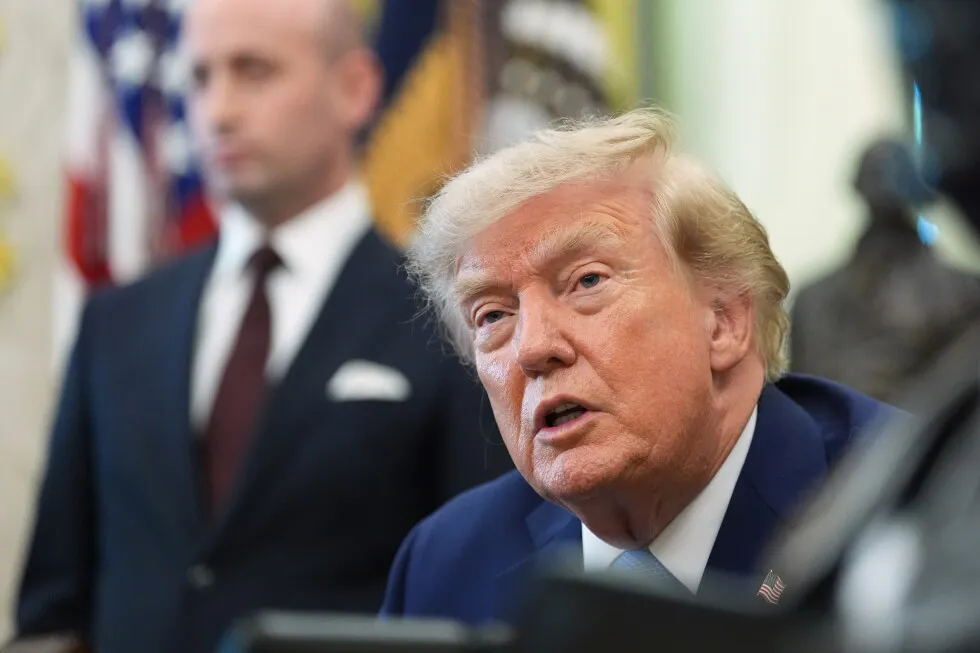
Trump signs 2 immigration actions to limit birthright citizenship and curb ‘birth tourism’ 1 of 2 | Additional details weren’t provided, but President Donald Trump said he thought his latest actions would be constitutional. In June, the Supreme Court rejected Trump’s previous efforts and upheld a broad conception of birthright citizenship. 2 of 2 | President Donald Trump speaks in the Oval Office of the White House, Thursday, Aug. 6, 2026, in Washington. (AP Photo/Alex Brandon) 1 of 2 Additional details weren’t provided, but President Donald Trump said he thought his latest actions would be constitutional. In June, the Supreme Court rejected Trump’s previous efforts and upheld a broad conception of birthright citizenship. Add AP News on Google Add AP News as your preferred source to see more of our stories on Google. Share 2 of 2 | President Donald Trump speaks in the Oval Office of the White House, Thursday, Aug. 6, 2026, in Washington. (AP Photo/Alex Brandon) 2 of 2 President Donald Trump speaks in the Oval Office of the White House, Thursday, Aug. 6, 2026, in Washington. (AP Photo/Alex Brandon) Add AP News on Google Add AP News as your preferred source to see more of our stories on Google. Share Updated [hour]:[minute] [AMPM] [timezone], [monthFull] [day], [year] Washington (AP) — President Donald Trump said Thursday that he is once more trying to limit the number of people who are born in the country who can become American citizens, in a sign that even after his first attempt at limiting birthright citizenship was rejected by the Supreme Court, he’s ready to try again. The president said he was signing two executive actions on immigration, including one limiting the number of people eligible for U.S. citizenship after being born in the United States. The written executive order released later Thursday was narrower in scope than the previous one shot down by the Supreme Court and appeared to focus on restricting automatic citizenship to specific categories of people, including children born to adults with connections to foreign embassies or organizations as well as anyone considered an “alien enemy” of the United States. It also aimed to restrict birthright citizenship to anyone whose parents “engaged in fraudulent activity to obtain citizenship.” A second order seeks to curb what Trump called “birth tourism” by increasing restrictions on visitors to the U.S. who want to obtain visas to give birth while in the country.Trump said he thought his latest actions would be constitutional. 1 MIN READ 3 MIN READ 3 MIN READ “I thought we were going to win it at the Supreme Court. Unfortunately, we had a bad decision, very unfair decision. Our country suffers because of it and we’re ending it a different way,” Trump said. In June, the Supreme Court rejected Trump’s previous efforts to declare that children born to people in the U.S. illegally or temporarily aren’t American citizens, and upheld a broad conception of birthright citizenship. On Trump’s first day in office of his second term, he signed an executive order aimed at ending birthright citizenship, which allows anyone born in the United States to automatically become an American citizen.Trump’s administration was immediately sued by opponents who said the executive order went against the 14th Amendment, adopted after the Civil War, which makes anyone born in the country a citizen, with very limited exceptions. The executive order was blocked by several lower courts and never took effect.In June, the Supreme Court struck down Trump’s order by a 6-3 vote. But the vote was too close for many immigration advocates and legal observers who felt the legal question of birthright citizenship was a long-settled issue. Weissert covers the White House for The Associated Press. He is based in Washington. Santana reports on the Department of Homeland Security, immigration policy and the federal agencies that touch on immigration. She’s reported on refugee resettlement, ICE operations and employment-based immigration and is reachable on Signal at RebeccaSantana.51.
SRCAssociated Press (AP)
LANGEN
LEANCenter
WORDS656
ENT10
THU · 2026-08-06 · 21:23 GMTBRIEF NSR-2026-0806-99899
NSR-2026-0806-99899News Report·EN·Legal & Judicial
Trump signs 2 immigration actions to limit birthright citizenship and curb ‘birth tourism’
President Donald Trump has signed two executive actions aimed at limiting birthright citizenship and curbing "birth tourism." One order seeks to restrict automatic U.S. citizenship for children born in the country to specific categories of individuals, including those with connections to foreign embassies or organizations, and those whose parents engaged in fraudulent activity.
By
WILL WEISSERT and REBECCA SANTANAAssociated Press (AP)Filed 2026-08-06 · 21:23 GMTLean · CenterRead · 3 min
Associated Press (AP)FIG 01
Reading time
3min
Word count
656words
Sources cited
1cited
Entities identified
10entities
Quality score
100%
§ 01
Briefing Summary
AI-generatedNEWSAR · AI
President Donald Trump has signed two executive actions aimed at limiting birthright citizenship and curbing "birth tourism." One order seeks to restrict automatic U.S. citizenship for children born in the country to specific categories of individuals, including those with connections to foreign embassies or organizations, and those whose parents engaged in fraudulent activity. The second order increases restrictions on visitors seeking visas to give birth in the U.S. Trump stated his belief that these actions are constitutional, despite the Supreme Court's previous rejection of his efforts to limit birthright citizenship for children of undocumented immigrants. The article notes that the Supreme Court upheld a broad conception of birthright citizenship in June.
Confidence 0.90Sources 1Claims 5Entities 10
§ 02
Article analysis
Model · rule-basedFraming
Legal & Judicial
Political Strategy
Tone
Measured
AI-assessed
CalmNeutralAlarmist
Factuality
0.70 / 1.00
Factual
LowHigh
Sources cited
1
Limited
FewMany
§ 03
Key claims
5 extracted01
The Supreme Court previously rejected Trump's efforts to deny citizenship to children of those in the U.S. illegally or temporarily.
factual
Confidence
1.00
02
Trump believes his latest actions will be constitutional, despite a previous Supreme Court rejection.
quotePresident Donald Trump
Confidence
1.00
03
President Donald Trump signed two executive actions on immigration aimed at limiting birthright citizenship and curbing 'birth tourism'.
factualPresident Donald Trump
Confidence
1.00
04
A second order aims to increase restrictions on visitors seeking visas to give birth in the U.S.
factual
Confidence
0.90
05
The new executive order is narrower than a previous one rejected by the Supreme Court and focuses on restricting citizenship for children of foreign embassy/organization adults and 'alien enemies'.
factual
Confidence
0.90
§ 04
Full report
3 min read · 656 words§ 05
Entities
10 identifiedKey playerOppositionContextPositiveNeutralNegative
Locations3
§ 06
Keywords & salience
10 termsbirth tourism
1.00
birthright citizenship
1.00
immigration actions
0.90
executive actions
0.80
supreme court
0.70
donald trump
0.70
u.s. citizenship
0.60
constitutional
0.50
visas
0.40
alien enemy
0.40
§ 07
Topic connections
Interactive graph Network visualization showing 51 related topics
View Full Graph Person Organization Location Event|Click node to navigate|Edge numbers = shared articles