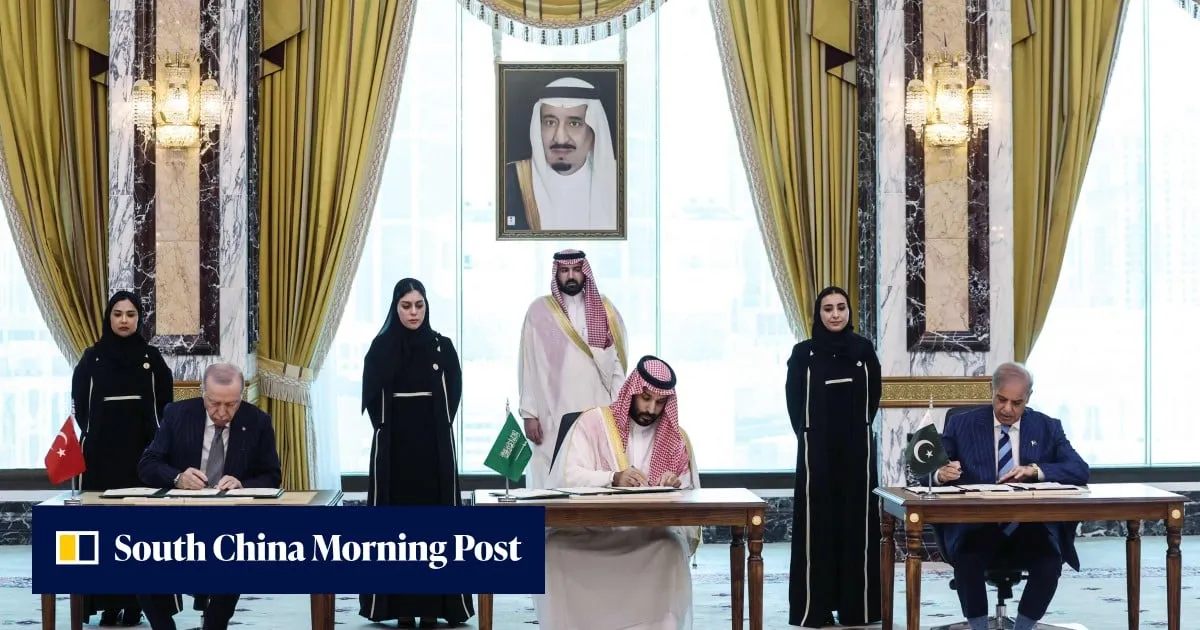
A defence pact among Saudi Arabia, Turkey and Pakistan appears to be aimed at deterring Iran and Israel from tearing up the Middle East with their conflict amid Washington’s inability to guarantee regional security, observers say.Under the terms of the deal signed on Friday in Mecca by Saudi Crown Prince Mohammed bin Salman, Turkish President Recep Tayyip Erdogan and Pakistani Prime Minister Shehbaz Sharif, an armed attack against any one of the three states “shall be regarded as an attack against them all”.No further details have been made public, but the signatories were quick to clarify that they had not formed a military coalition, and that the agreement served as a deterrent.In a social media post, Saudi Deputy Minister for Public Diplomacy Rayed Krimly said the pact “does not threaten the security of any country in the region and should not be viewed as an escalation of tensions between any two states”.Erdogan followed suit, saying the agreement “targets no country and is open to the participation of all brotherly countries that aim for the peace, prosperity, and stability of our region”.Former Qatari prime minister Hamad bin Jassim bin Jaber al-Thani described the tripartite pact as “a step that calls for optimism” and expressed hope that other Gulf Cooperation Council members would “take the initiative to join it”.Analysts see Qatar as an obvious candidate to join the pact because of its pre-existing defence agreement with Turkey. Kuwait is also a potential signatory following ratification of its expanded defence cooperation agreement with Pakistan in July.
SRCSouth China Morning Post
LANGEN
LEANCenter-Right
WORDS253
ENT12
SUN · 2026-08-09 · 08:00 GMTBRIEF NSR-2026-0809-100559
NSR-2026-0809-100559Analysis·EN·National Security
How Saudi Arabia-Turkey-Pakistan defence pact acts as ‘insurance’ over US disengagement
Saudi Arabia, Turkey, and Pakistan have signed a defense pact in Mecca, aiming to deter regional conflicts and address perceived US disengagement in guaranteeing security. The agreement, signed by Crown Prince Mohammed bin Salman, President Recep Tayyip Erdogan, and Prime Minister Shehbaz Sharif, states that an armed attack against one signatory will be considered an attack against all three.
Tom HussainSouth China Morning PostFiled 2026-08-09 · 08:00 GMTLean · Center-RightRead · 2 min
South China Morning PostFIG 01
Reading time
2min
Word count
253words
Sources cited
4cited
Entities identified
12entities
Quality score
100%
§ 01
Briefing Summary
AI-generatedNEWSAR · AI
Saudi Arabia, Turkey, and Pakistan have signed a defense pact in Mecca, aiming to deter regional conflicts and address perceived US disengagement in guaranteeing security. The agreement, signed by Crown Prince Mohammed bin Salman, President Recep Tayyip Erdogan, and Prime Minister Shehbaz Sharif, states that an armed attack against one signatory will be considered an attack against all three. While details are limited, the signatories emphasized it is a deterrent, not a military coalition, and does not threaten any country's security or escalate tensions. Analysts suggest other Gulf Cooperation Council members, like Qatar and Kuwait, could potentially join the pact.
Confidence 0.90Sources 4Claims 5Entities 12
§ 02
Article analysis
Model · rule-basedFraming
National Security
Diplomatic
Tone
Measured
AI-assessed
CalmNeutralAlarmist
Factuality
0.60 / 1.00
Mixed
LowHigh
Sources cited
4
Well sourced
FewMany
§ 03
Key claims
5 extracted01
The agreement targets no country and is open to the participation of all brotherly countries that aim for peace, prosperity, and stability.
quoteRecep Tayyip Erdogan
Confidence
1.00
02
The pact does not threaten the security of any country in the region and should not be viewed as an escalation of tensions.
quoteSaudi Deputy Minister for Public Diplomacy Rayed Krimly
Confidence
1.00
03
An armed attack against any one of the three states shall be regarded as an attack against them all.
factualpact signatories
Confidence
1.00
04
Qatar is an obvious candidate to join the pact due to its pre-existing defense agreement with Turkey.
factualAnalysts
Confidence
0.70
05
A defense pact among Saudi Arabia, Turkey, and Pakistan appears aimed at deterring Iran and Israel.
factualobservers
Confidence
0.70
§ 04
Full report
2 min read · 253 words§ 05
Entities
12 identifiedKey playerOppositionContextPositiveNeutralNegative
People5
§ 06
Keywords & salience
10 termsdefence pact
1.00
saudi arabia
0.90
turkey
0.90
pakistan
0.90
regional security
0.80
deterrent
0.70
israel
0.60
iran
0.60
us disengagement
0.50
qatar
0.40
§ 07
Topic connections
Interactive graph Network visualization showing 51 related topics
View Full Graph Person Organization Location Event|Click node to navigate|Edge numbers = shared articles