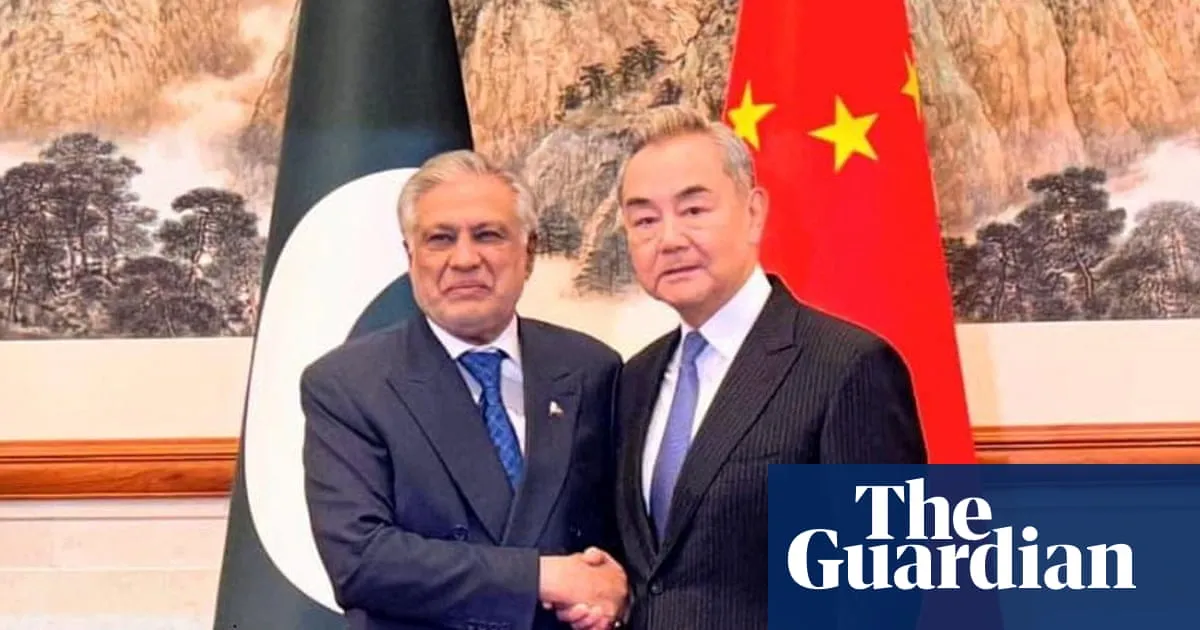
Pakistan and China have released a joint five-part proposal for peace in the Middle East, after Pakistan’s foreign minister flew to Beijing on Tuesday to seek Chinese support for the country’s faltering efforts to negotiate an end to end the war.The one-day meeting between Ishaq Dar and his Chinese counterpart, Wang Yi, came as Pakistan continues to push for the role of peacemaker between the United States and Iran, even as the war shows little sign of relenting.According to a statement from China’s foreign ministry, the trip was intended to “strengthen” cooperation between China and Pakistan on the ongoing conflict in Iran and “make new efforts toward advocating for peace”.So far, China has maintained a meticulous distance from the ongoing conflict in the Middle East and the Gulf, though it has ties with the regime in Tehran and is the largest buyer of Iranian oil.While Beijing condemned the initial US and Israeli strikes on Iran, it has since held a position largely of neutrality and focused its efforts on calling for a ceasefire, while negotiating directly with Tehran for the safe passage of its own oil tankers through the Strait of Hormuz.In a statement after Tuesday’s meeting, Pakistan and China jointly called for an immediate ceasefire and for the safety of waterways, including the blockaded strait, to be protected, and released a five-part initiative for peace.The joint statement agreed that dialogue and diplomacy were “the only viable option to resolve conflicts” but there appeared to be little substantive progress in bringing the significant participants to the table to end the war.This week Trump claimed that negotiations with Iran were going “extremely well” while Tehran has maintained there are no direct talks happening at all.In recent weeks, Pakistan has put itself at the centre of efforts to bring about a ceasefire to end the war with Iran and has been pushing for Islamabad as the location for peace talks.Playing on its relationships with both sides, Pakistan’s prime minister, Shehbaz Sharif, and army chief, Syed Asim Munir, have been communicating with the US president, Donald Trump, and the Iranian president, Masoud Pezeshkian, as well as dozens of other global leaders, and messages between the two warring countries have passed through Pakistani intermediaries.On Sunday, Islamabad hosted talks with the foreign ministers of Saudi Arabia, Turkey and Egypt, in an effort to find a regional solution to ending the conflict, yet the absence of the US and Iran from the negotiations was seen to undermine their diplomatic heft.Analysts said Pakistan’s fervent embrace of the role of interlocutor between Iran and the US came after years of Islamabad being sidelined by Washington under previous presidents and a push by the government and Munir for the country to be seen as a regional diplomatic heavyweight.Rafiullah Kakar, a Pakistani columnist and political analyst, said: “Islamabad seeks to reinforce its standing as a consequential middle power within the broader Muslim world and to signal continued geopolitical importance to external partners, particularly Washington and the Gulf states.”Yet as analysts and political figures have emphasised, Pakistan also has its own significant stakes in ending the conflict, and has already been paying a heavy economic price for the blockade on fuel and gas through the Strait of Hormuz.Pakistan shares a 560-mile (900km) land border with Iran, and there are fears that the conflict could spill over into the restive region of Balochistan, which is already battling a violent insurgency.It is also home to the world’s largest population of Shia Muslims outside Iran and there are fears the conflict could stir up sectarian tensions if it continues to drag on. Dozens were already killed in protests that broke out when the US and Israel began bombing Tehran.The country also has a freshly signed defence pact with Saudi Arabia, which could threaten to drag a reluctant Islamabad into the war if countries in the Gulf decide to shift to an offensive tack and fight back against Iran’s missile and drone strikes.Kakar said Pakistan’s strong interest in de-escalating the conflict in Iran reflected both geopolitical and domestic concerns, with fears it could further undermine the country’s already highly unstable security situation.“Pakistan remains economically dependent on the Gulf monarchies, particularly Saudi Arabia, and seeks to preserve stable relations with the United States – yet it also shares a long and sensitive border with Iran,” he said.“Serious instability in Iran would have direct implications for Pakistan’s security. Escalation risks placing Islamabad in a very difficult position.”
SRCThe Guardian - World News
LANGEN
LEANCenter-Left
WORDS740
ENT12
TUE · 2026-03-31 · 15:30 GMTBRIEF NSR-2026-0331-45674
NSR-2026-0331-45674News Report·EN·Diplomatic
Pakistan and China propose five-part peace plan for Middle East
Pakistan and China have jointly proposed a five-part peace plan for the Middle East, following a meeting between Pakistani and Chinese foreign ministers in Beijing. Pakistan is seeking to play a peacemaking role between the United States and Iran amidst ongoing conflict.
Hannah Ellis-Petersen in Delhi and Shah Meer Baloch in IslamabadThe Guardian - World NewsFiled 2026-03-31 · 15:30 GMTLean · Center-LeftRead · 3 min
The Guardian - World NewsFIG 01
Reading time
3min
Word count
740words
Sources cited
4cited
Entities identified
12entities
Quality score
100%
§ 01
Briefing Summary
AI-generatedNEWSAR · AI
Pakistan and China have jointly proposed a five-part peace plan for the Middle East, following a meeting between Pakistani and Chinese foreign ministers in Beijing. Pakistan is seeking to play a peacemaking role between the United States and Iran amidst ongoing conflict. The proposal emphasizes dialogue and diplomacy as the solution, calling for an immediate ceasefire and protection of waterways. Pakistan has been actively communicating with leaders from the US, Iran, Saudi Arabia, Turkey, and Egypt, positioning itself as a mediator and offering Islamabad as a location for peace talks. China, while maintaining neutrality, has expressed concern for the safety of its oil tankers and called for a ceasefire.
Confidence 0.90Sources 4Claims 5Entities 12
§ 02
Article analysis
Model · rule-basedFraming
Diplomatic
Political Strategy
Tone
Measured
AI-assessed
CalmNeutralAlarmist
Factuality
0.70 / 1.00
Factual
LowHigh
Sources cited
4
Well sourced
FewMany
§ 03
Key claims
5 extracted01
Islamabad hosted talks with the foreign ministers of Saudi Arabia, Turkey and Egypt.
factualArticle
Confidence
1.00
02
Trump claimed that negotiations with Iran were going “extremely well”.
quoteTrump
Confidence
1.00
03
Pakistan continues to push for the role of peacemaker between the United States and Iran.
factualArticle
Confidence
1.00
04
Pakistan and China have released a joint five-part proposal for peace in the Middle East.
factualArticle
Confidence
1.00
05
China has maintained a meticulous distance from the ongoing conflict in the Middle East and the Gulf.
factualArticle
Confidence
0.90
§ 04
Full report
3 min read · 740 words§ 05
Entities
12 identifiedKey playerOppositionContextPositiveNeutralNegative
People4
§ 06
Keywords & salience
10 termsmiddle east
0.90
peace plan
0.90
pakistan
0.80
china
0.80
ceasefire
0.70
iran
0.60
dialogue and diplomacy
0.60
war
0.50
negotiations
0.50
peace talks
0.40
§ 07
Topic connections
Interactive graph Network visualization showing 51 related topics
View Full Graph Person Organization Location Event|Click node to navigate|Edge numbers = shared articles