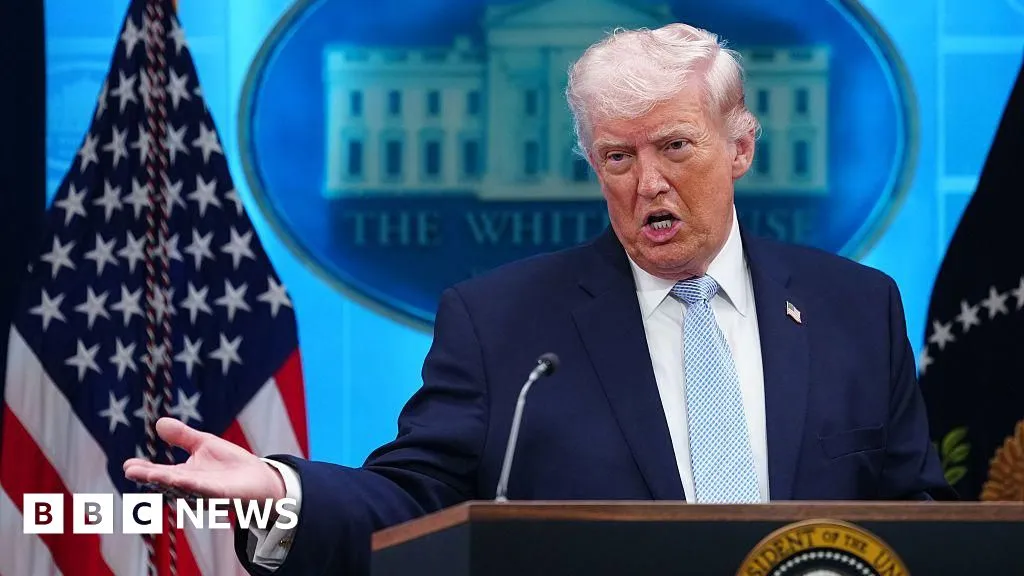
2 hours agoBernd Debusmann Jr & Tom Batemanat the White House Getty ImagesTrump said that Nato's failure to participate in the US operation in Iran will long be rememberedUS President Donald Trump has threatened to take out Iran "in one night" if it fails to make a deal before the deadline he set for Tehran to reopen the Strait of Hormuz, a critical global energy route.Trump's deadline for an "acceptable" deal - one that includes the free flow of energy through the Gulf - is set for 20:00EDT (01:00GMT) on Tuesday. Speaking at the White House on Monday, Trump said that he believed "reasonable" leaders in Iran were negotiating in "good faith", but the outcome remained uncertain. Iran has so far rejected proposals for a ceasefire, and has instead called for an immediate end to hostilities, post-conflict reconstruction and the lifting of sanctions.Trump's news conference held alongside General Dan Caine, the chairman of the Joint Chiefs of Staff and defence secretary Pete Hegseth comes days after US forces successfully recovered two crew members of an F-15 fighter jet that was downed in southern Iran. While much of Trump's remarks highlighted what he described as the "heroic" rescue of the crew, he once again repeated his warning that the US could launch attacks on Iran's energy and transportation infrastructure if the Strait of Hormuz was not reopened by Tuesday's deadline."The entire country can be taken out in one night – and that night might be tomorrow night," he said on Monday.Once the deadline passes, Trump added, Iran would be sent back to the "Stone Ages". "They're going to have no bridges," he said. "They're going to have no power plants." Despite Iran's earlier rejection of US demands, Trump continued to express optimism that Iran was negotiating in good faith after successive layers of Iranian leadership were killed in US and Israeli strikes. "We're going to find out," he said. Meaningful progress in any negotiation is unlikely to take place without a ceasefire first, according to a regional official familiar with the discussions. The official - who asked to remain anonymous due to the sensitivity of talks - said that talks were complicated because of difficulties in getting messages to and from Iranian officials amid an ongoing communications blackout. "To convey messages to Iran, getting a response in a reasonable time is not possible," the official said. "The average time of response has been a day or so." Pakistan, Turkey and Egypt have all been involved in efforts to mediate. Trump provided few other details as to the administration's plans going forward, saying only that he has "the best plan" but that he won't divulge it to the media. Legal experts have warned that deliberate, sustained assaults on Iranian infrastructure could constitute a war crime. "Obliterating all power plants, threatening coercive actions against the civilian population to try to bring a government to the negotiating table, those kinds of things are all flatly illegal," former Obama-era National Security Council legal advisor told CBS, the BBC's US partner.Earlier in the day, Trump said he was not "worried" about that possibility, and in the news conference insisted that Iran's population would be "willing to suffer to have freedom" - even if toppling Iran's government was not his intention.The president also renewed his criticism of key US allies - including the UK, Nato and South Korea - that he said had failed to come to the help of the US during the conflict."That's a mark on Nato that will never disappear," he said, adding that the US does not "need" the UK.American forces have conducted over 13,000 strikes across Iran since the war began, according to an update from the US military's Central Command on Monday.Trump says negotiations are on-going with Iran: BBC reports from White House
SRCBBC News - World
LANGEN
LEANCenter
WORDS632
ENT11
MON · 2026-04-06 · 21:55 GMTBRIEF NSR-2026-0406-55314
NSR-2026-0406-55314News Report·EN·National Security
Trump threatens to take out Iran in 'one night' if no deal before deadline
President Trump has threatened military action against Iran if it fails to meet his deadline of Tuesday at 8:00 PM EDT to reopen the Strait of Hormuz. Speaking at the White House, Trump stated that the U.S.
BBC News - WorldFiled 2026-04-06 · 21:55 GMTLean · CenterRead · 3 min
BBC News - WorldFIG 01
Reading time
3min
Word count
632words
Sources cited
3cited
Entities identified
11entities
Quality score
100%
§ 01
Briefing Summary
AI-generatedNEWSAR · AI
President Trump has threatened military action against Iran if it fails to meet his deadline of Tuesday at 8:00 PM EDT to reopen the Strait of Hormuz. Speaking at the White House, Trump stated that the U.S. could "take out" Iran "in one night," targeting its energy and transportation infrastructure, and send the country "back to the Stone Ages" if the deadline is missed. While Iran has rejected previous ceasefire proposals and called for sanctions relief, Trump expressed optimism that negotiations were progressing in good faith. However, a regional official indicated that communication blackouts and delayed responses from Iranian officials are complicating negotiations. The threat comes after the U.S. successfully rescued crew members from a downed fighter jet in southern Iran.
Confidence 0.90Sources 3Claims 5Entities 11
§ 02
Article analysis
Model · rule-basedFraming
National Security
Political Strategy
Tone
Mixed Tone
AI-assessed
CalmNeutralAlarmist
Factuality
0.70 / 1.00
Factual
LowHigh
Sources cited
3
Well sourced
FewMany
§ 03
Key claims
5 extracted01
"The entire country can be taken out in one night – and that night might be tomorrow night," he said on Monday.
quoteTrump
Confidence
1.00
02
Iran has so far rejected proposals for a ceasefire.
factualarticle
Confidence
1.00
03
Trump's deadline for an "acceptable" deal is set for 20:00EDT (01:00GMT) on Tuesday.
factualarticle
Confidence
1.00
04
Trump threatened to take out Iran "in one night" if it fails to make a deal before the deadline he set for Tehran to reopen the Strait of Hormuz.
factualarticle
Confidence
1.00
05
Meaningful progress in any negotiation is unlikely to take place without a ceasefire first.
predictionregional official
Confidence
0.70
§ 04
Full report
3 min read · 632 words§ 05
Entities
11 identifiedKey playerOppositionContextPositiveNeutralNegative
§ 06
Keywords & salience
9 termsiran
1.00
donald trump
0.90
threat
0.80
military action
0.70
strait of hormuz
0.70
deadline
0.60
negotiations
0.60
energy
0.50
sanctions
0.40
§ 07
Topic connections
Interactive graph Network visualization showing 51 related topics
View Full Graph Person Organization Location Event|Click node to navigate|Edge numbers = shared articles