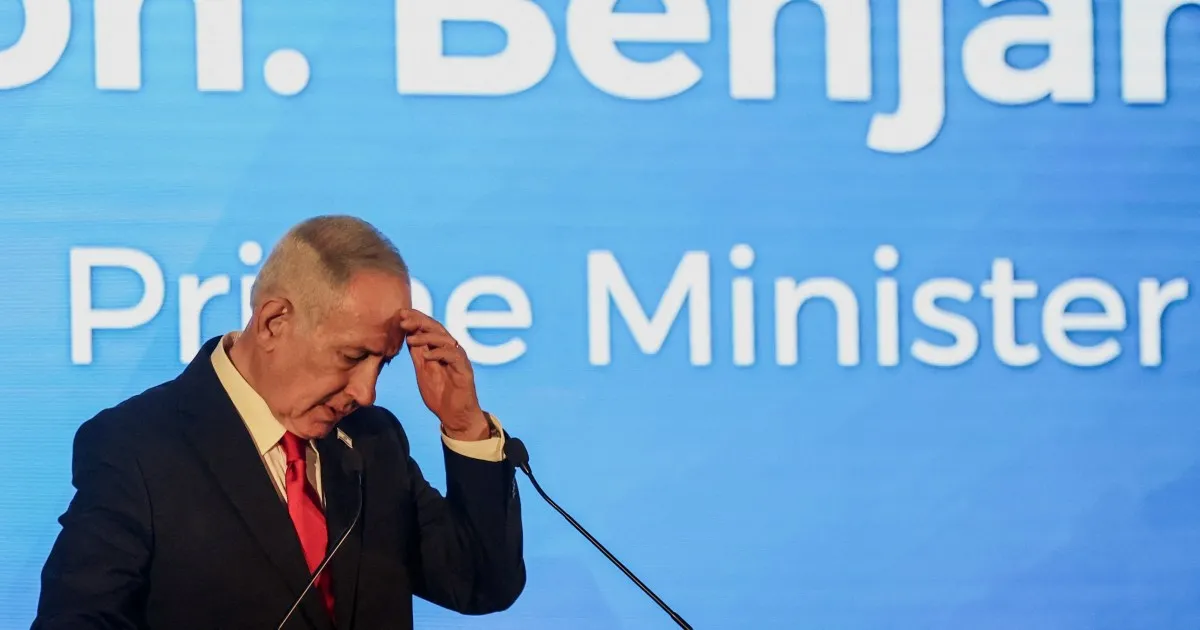
Israel’s confrontation with its regional nemesis leaves Iran standing and strategically stronger, analysts say.Israeli Prime Minister Benjamin Netanyahu gestures as he speaks during the Conference of Presidents of Major American Jewish Organisations, in Jerusalem, February 15, 2026 [Ronen Zvulun/Reuters]Published On 8 Apr 2026As Israel contemplates a two-week ceasefire announced by United States President Donald Trump in the war on Iran on Tuesday night, it appears weakened in the eyes of its opponents and critics. Its arch-nemesis, Iran, is still standing; Israel’s defensive stock of missiles is depleted and its prime minister is facing a political backlash.Following news of the Pakistan-brokered truce, Prime Minister Benjamin Netanyahu’s office issued a statement in English, saying that the PM supports the US decision and claiming that “Iran no longer poses a nuclear, missile and terror threat to America, Israel, Iran’s Arab neighbours and the world.”Recommended Stories list of 4 itemslist 1 of 4Photos: Tehran celebrates as Iran, US agree to two-week ceasefirelist 2 of 4GCC, other Middle East nations react to Iran-US ceasefire announcementlist 3 of 4US-Iran ceasefire deal: What are the terms, and what’s next?list 4 of 4Lebanon excluded from ceasefire as Israeli strikes continueend of listBut there was a caveat. While mediator Pakistan had announced that Israeli attacks on Hezbollah in Lebanon would also cease, Netanyahu added that he does not regard the ceasefire as extending to Israel’s war on Lebanon, which, for now at least, the US appears willing to allow to continue, subject to its peace negotiations with Iran.Responding to Netanyahu’s announcement, Israel’s opposition leader, Yair Lapid, who had strongly supported his country’s attack on regional nemesis Iran, called the ceasefire one of the greatest “political disasters in all of our history”. Israel had not even been involved in negotiations, he said, adding that, despite its military successes, the prime minister had “failed politically, failed strategically, and didn’t meet a single one of the goals that he himself set”, adding that it would take years to repair the damage inflicted upon the country through the prime minister’s “arrogance”.Others were swift to join in the bashing. “I wasn’t surprised that the announcement was in English,” Ofer Cassif of the left-wing Hadash party said. “Netanyahu has no interest in talking to the people of Israel. He rarely does and almost never enters the [television or radio] studio,” he said of the prime minister, who waited two weeks to spell out his war aims to the Israeli public in a televised address after the start of the war on Iran.“He knows, probably correctly, that those who support him will do so anyway, and those who oppose him will continue to do so, so when he speaks, it’s to the international media and to reassure his base,” Cassif said.Netanyahu’s war aimsThose war aims, as stated by Netanyahu, of preventing “Iran from developing nuclear weapons” and of creating ” the conditions for the Iranian people so they can remove the cruel regime of tyranny”, were merely the latest iteration of Israel’s longstanding strategic goals. Indeed, Netanyahu has been claiming Iran’s potential to develop a nuclear weapon was imminent since the 1990s.But, despite significant military successes over the past 40 days of attacks on Iran, neither of those goals has been achieved.“The Israelis are deeply disappointed with the ceasefire as none of the original aims of the war have been achieved,” Ahron Bregman, a senior teaching fellow at the Department for War Studies at King’s College London, who has recently returned from Israel, said. “The Iranian regime is still in place, its ballistic missile programme could be rebuilt very quickly, and it’s still got 440kg of enriched uranium at 60 percent purity, enough for 10 bombs.”In fact, according to many observers, despite significant military defeats, including the loss of control over its airspace, the assassination of much of its leadership – including Ayatollah Ali Khamenei, who was killed on the first day of the war, as well as many of Iran’s key military figures – Iran has, counterintuitively, emerged stronger as a result, analysts say.“Israel and the US had many tactical gains. They won militarily, but, strategically, Iran is the clear victor,” Bregman said.A strategic blunder?Key among its victories was not just the Iranian government’s survival in the face of relentless Israeli and US military strikes, but also its decision to close the Strait of Hormuz, one of the world’s key energy arteries and, according to current negotiations, one where safe passage for international shipping is now entirely under the control of Iran and its neighbour Oman.Iran has been struggling under increased US sanctions after Trump, with Netanyahu’s encouragement, unilaterally withdrew from an international deal to limit its nuclear programme in return for reduced economic sanctions in 2018. However, many observers now expect Iran to continue with newly imposed levies on ships for safe passage through the Strait. Also supporting the Iranian economy are Trump’s promises, posted on Truth Social on Wednesday, of future sanctions and tariff relief as part of the ceasefire arrangement.“Iran’s decision to block the Hormuz pushed Trump off balance, and he never recovered,” Bregman said. “Future historians will regard this Iranian decision as the turning point in the war.”According to some observers, Israel’s conduct during the war has also served to strengthen the Iranian government. Some centres of opposition, such as Tehran’s Sharif University, which had been a focal point of antigovernment protests in January, have been destroyed in Israeli attacks. Donald Trump’s 11th-hour threat to wipe out Iranian civilisation also allowed the Iranian government to beam out rallying images of citizens forming human chains around critical infrastructure.“Please understand, I despise the Iranian regime; it’s murderous,” Cassif told Al Jazeera on Wednesday. “But we [Hadash] had warned from second number one that we didn’t have the right, or the ability, to change it. Instead, we’ve strengthened the support for that regime at the expense of the opposition,” he said of reports of the surge in support for the Iranian government in the face of US and Israeli attacks.Israel and the US had, he said, “given operational control of the Strait of Hormuz to Iran, which had never been an issue before, and, with the first aggressions coming while negotiations were under way, signalled to the entire world that they can’t trust the US and Israel”.Cargo ships in the Gulf, near the Strait of Hormuz, as seen from northern Ras al-Khaimah, near the border with Oman’s Musandam governance [Stringer/Reuters]‘Israel has achieved nothing tangible’Then there is Israel’s assault on southern and eastern Lebanon, where it claims it is targeting Hezbollah strongholds. Whether it will continue with these attacks remains to be seen.For now, Israel is not expected to attend peace talks in Pakistan on Friday. But that is where, according to Bregman, its freedom to continue attacks on Lebanon may be determined by the US and Hezbollah’s allies in Tehran.“Assuming the ceasefire holds beyond the two-week period, Israel achieved almost nothing tangible,” Alon Pinkas, a former Israeli ambassador and consul general in New York, told Al Jazeera of its war on Iran. “Iran upended the strategic asymmetry by both attacking the Arab Gulf states and, crucially, shutting the Strait of Hormuz with almost no pushback from China. Israel is increasingly perceived as a destabilising force and, arguably, strained the US relationship since all promises Netanyahu made to Trump unravelled,” he said, referring to reported assurances of swift regime change in Iran that Israel made.
SRCAl Jazeera
LANGEN
LEANCenter
WORDS1 230
ENT11
WED · 2026-04-08 · 13:34 GMTBRIEF NSR-2026-0408-58668
NSR-2026-0408-58668News Report·EN·Political Strategy
Defeat from the jaws of victory: Israel reacts to Trump’s Iran ceasefire
Following a two-week ceasefire in the war on Iran brokered by the US and Pakistan, Israel faces a weakened position, according to analysts. Announced by US President Donald Trump in April 2026, the ceasefire leaves Iran standing, despite Israel's military actions.
Simon Speakman CordallAl JazeeraFiled 2026-04-08 · 13:34 GMTLean · CenterRead · 5 min
Al JazeeraFIG 01
Reading time
5min
Word count
1 230words
Sources cited
4cited
Entities identified
11entities
Quality score
100%
§ 01
Briefing Summary
AI-generatedNEWSAR · AI
Following a two-week ceasefire in the war on Iran brokered by the US and Pakistan, Israel faces a weakened position, according to analysts. Announced by US President Donald Trump in April 2026, the ceasefire leaves Iran standing, despite Israel's military actions. While Prime Minister Benjamin Netanyahu supports the US decision, claiming Iran no longer poses a significant threat, he asserts the ceasefire doesn't extend to Israel's conflict with Lebanon. This stance has drawn strong criticism from Israeli opposition leader Yair Lapid, who calls the ceasefire a political disaster, accusing Netanyahu of failing strategically and politically. Other Israeli figures have also criticized Netanyahu's handling of the situation and communication regarding the ceasefire.
Confidence 0.90Sources 4Claims 5Entities 11
§ 02
Article analysis
Model · rule-basedFraming
Political Strategy
National Security
Tone
Measured
AI-assessed
CalmNeutralAlarmist
Factuality
0.60 / 1.00
Mixed
LowHigh
Sources cited
4
Well sourced
FewMany
§ 03
Key claims
5 extracted01
Ofer Cassif said Netanyahu has no interest in talking to the people of Israel.
quoteOfer Cassif
Confidence
1.00
02
Yair Lapid called the ceasefire one of the greatest “political disasters in all of our history”.
quoteYair Lapid
Confidence
1.00
03
Netanyahu does not regard the ceasefire as extending to Israel’s war on Lebanon.
factualBenjamin Netanyahu
Confidence
1.00
04
Netanyahu supports the US decision and claims Iran no longer poses a nuclear, missile and terror threat.
quoteBenjamin Netanyahu's office
Confidence
1.00
05
Trump announced a two-week ceasefire in the war on Iran.
factualArticle
Confidence
1.00
§ 04
Full report
5 min read · 1 230 words§ 05
Entities
11 identifiedKey playerOppositionContextPositiveNeutralNegative
People4
§ 06
Keywords & salience
10 termsceasefire
1.00
iran
0.90
israel
0.90
regional nemesis
0.70
political backlash
0.70
us decision
0.60
benjamin netanyahu
0.60
peace negotiations
0.50
lebanon
0.50
strategic failure
0.40
§ 07
Topic connections
Interactive graph Network visualization showing 51 related topics
View Full Graph Person Organization Location Event|Click node to navigate|Edge numbers = shared articles