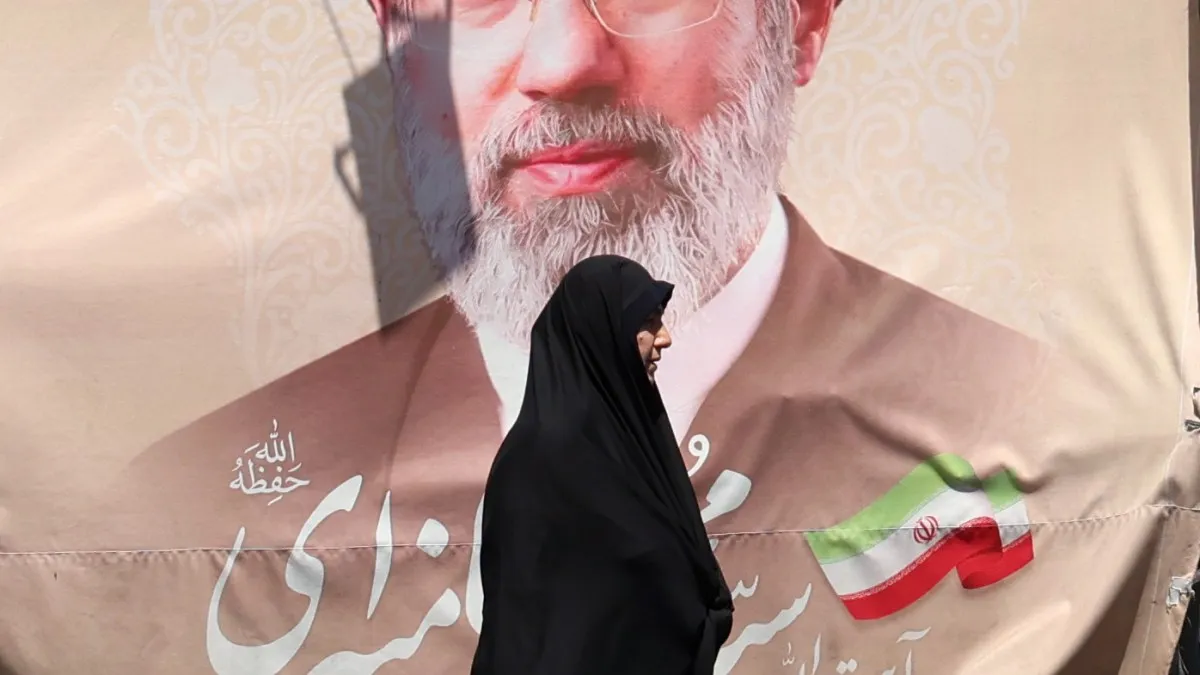
PM Shehbaz Sharif praises army chief and his ministers for their efforts in securing a tentative deal, likely to be finalised in Geneva later this week.A billboard in Tehran shows Mojtaba Khamenei, who replaced his father as Iran's supreme leader after Ali Khamenei was killed on the first day of the Iran" class="entity-link entity-event" data-entity-id="38678" data-entity-type="event">US-Israel war on Iran [Abedin Taherkenareh/EPA]Published On 15 Jun 2026Islamabad, Pakistan – Pakistani Prime Minister Shehbaz Sharif says there were moments in the final stretch of negotiations between the United States and Iran when the talks appeared close to collapse.Each time, he told the National Assembly on Monday, it was Field Marshal Asim Munir, Pakistan’s powerful military chief, who kept the deliberations alive.Recommended Stories list of 4 itemslist 1 of 4Iran war day 108: Iran, US reach a tentative deal to end conflictlist 2 of 4US, Iran to sign a ‘peace deal’ on Friday: What we knowlist 3 of 4World reacts as Iran and US reach tentative deal to end warlist 4 of 4Iran, US agree tentative deal to ‘end war’: Your questions answeredend of list“Throughout this period, he was awake all day and night,” Sharif told lawmakers, adding that Munir had “sacrificed day and night to extinguish the flames of war”.There were many moments, he said, when “it felt like the negotiations would come to a halt” but the army chief did not give up. “If this journey had not continued,” Sharif said, “the dream of peace would have been shattered.”The acknowledgement, unusually specific for a process conducted almost entirely out of public view, offered the clearest glimpse yet into how Pakistan pulled off what many had considered an improbable task: brokering a deal to end more than three months of a war that has killed thousands of people, mostly in Iran and Lebanon, and disrupted global energy markets.Sharif also praised Deputy Prime Minister and Foreign Minister Ishaq Dar and his team and Interior Minister Mohsin Naqvi for their “tireless efforts” while paying tribute to the leaders of Qatar, Saudi Arabia, Turkiye and China for their roles in the mediation.Pakistan’s military and its Ministries of Foreign Affairs and Information and Broadcasting did not respond to Al Jazeera’s requests for details of the US-Iran agreement.‘Extremely difficult circumstances’The agreement, announced early on Monday when Sharif broke the news on X, calls for an immediate and permanent end to military operations on all fronts, including in Lebanon.US President Donald Trump confirmed the deal shortly afterwards on his Truth Social platform. “The Deal with the Islamic Republic of Iran is now complete,” he wrote.A signing ceremony hosted by Pakistan is scheduled for Friday in Geneva.Under the 14-point memorandum of understanding, according to Iran’s Mehr News Agency, the US has committed to lifting its naval blockade of Iran within 30 days and withdrawing its forces deployed near Iran.The Strait of Hormuz, which has in effect been shut by Iran since the war began on February 28, is to reopen for normal transit under the agreement.Iran’s frozen assets, estimated at $24bn, are also likely to be released in phases over the ensuing 60 days of further negotiations, during which both sides are expected to address the issue of Iran’s nuclear programme.Discussions on Iran’s missile programme and its support for armed groups have been removed from the immediate agenda, according to the Iranian news agency.The negotiations were conducted under Iran’s new supreme leader, Mojtaba Khamenei, who succeeded his father, Ayatollah Ali Khamenei, after the elder Khamenei was killed on February 28, the first day of the Iran" class="entity-link entity-event" data-entity-id="38678" data-entity-type="event">US-Israel war on Iran.Sharif on Monday specifically named the supreme leader among the leaders who had demonstrated “immense wisdom, prudence and patience under extremely difficult circumstances” during the negotiations.‘Never-give-up approach’Pakistan’s path to the announcement was neither linear nor, by most accounts, straightforward.A Pakistan-brokered ceasefire began on April 8 after Munir made a flurry of calls to US officials in the hours before a Trump deadline to strike Iran expired, and the ceasefire held, but only narrowly. Trump subsequently extended it indefinitely upon the “personal request” of Munir and Sharif, according to Pakistani officials.On April 11 and 12, Pakistan hosted the Islamabad talks, marking the highest-level direct engagement between Washington and Tehran since 1979. But the talks, attended by US Vice President JD Vance, ended without an agreement.For weeks afterwards, face-to-face negotiations did not resume. At one point, Trump said the two sides could speak by phone if needed.Meanwhile, Pakistani officials continued shuttling between Washington, DC, and Tehran, but publicly, there was little indication of progress.Jauhar Saleem, a former Pakistani diplomat, said the arc of Islamabad’s mediation reflected something more fundamental than tactical adjustment.“It’s not a question of what changed between April and June. It’s rather an example of a never-give-up approach in diplomacy where an honest broker respected by both sides can eventually help overcome an overwhelming trust deficit,” Saleem told Al Jazeera.Pakistan’s task, he said, was not only to bridge the gap between the warring parties’ positions but also to help navigate the divide between pragmatists and hardliners within each country, particularly Iran.“Pakistan’s leverage was and remains its credibility as a trusted friend and well-wisher and a fair intermediary,” he said.But Pakistan was not working alone.On March 31, Pakistan and China signed a joint five-point peace plan aimed at ending the war. Beijing’s involvement reflected its concerns over the blockade of the Strait of Hormuz, through which much of China’s oil and gas imports pass.In May, Munir travelled to Tehran for a second time. Naqvi, whom Sharif on Monday credited for engaging “with Iranian brothers”, accompanied him.Iranian Foreign Minister Abbas Araghchi also made multiple visits to Islamabad during the same period, meeting separately with both Munir and Sharif. During one such visit, Araghchi said Tehran intended to engage with Pakistan’s mediators “until a result is achieved”.Final hoursBy Saturday, Dar was speaking with his counterparts in Saudi Arabia, Turkiye and Egypt as negotiations entered what Pakistani officials described as their final phase.Saudi Foreign Minister Faisal bin Farhan Al Saud specifically acknowledged Pakistan’s “consistent and sustained efforts in support of mediation and dialogue throughout the process”, according to Pakistan’s Foreign Ministry.That same day, Sharif said the US and Iran had reached a “final, agreed-upon text”, adding: “Peace has never been this close as it is now.”Iran’s Ministry of Foreign Affairs, however, said there were no plans for its negotiating team to travel to sign an agreement in the coming days, a public indication that the final hours remained uncertain.An Israeli strike on the southern suburbs of Beirut on Sunday, hours before the deal was announced, triggered an angry response from Tehran.Iranian parliament Speaker Mohammad Bagher Ghalibaf questioned whether Washington had either the “will or the ability” to enforce its commitments. Despite the sharp rhetoric, Iranian President Masoud Pezeshkian signalled that diplomacy remained alive.Pakistani officials have declined to comment on the finer details of the negotiations or what unfolded in the final hours. The precise mechanics of how the agreement survived that moment remained unclear.What is known is that Sharif posted on X shortly afterwards, announcing the tentative deal. Trump confirmed it minutes later.“Nations have sought for decades the respect and honour which has been awarded to Pakistan for its efforts in the peace process,” the Pakistani prime minister told lawmakers on Monday.
SRCAl Jazeera
LANGEN
LEANCenter
WORDS1 202
ENT12
MON · 2026-06-15 · 13:06 GMTBRIEF NSR-2026-0615-84593
NSR-2026-0615-84593News Report·EN·Diplomatic
How Pakistan mediated a US-Iran agreement after more than 100 days of war
Pakistani Prime Minister Shehbaz Sharif announced that Pakistan successfully mediated a tentative agreement between the United States and Iran to end over 100 days of war. Sharif specifically praised Pakistan's Army Chief, Field Marshal Asim Munir, for his persistent efforts in keeping negotiations alive during critical moments.
Abid HussainAl JazeeraFiled 2026-06-15 · 13:06 GMTLean · CenterRead · 5 min
Al JazeeraFIG 01
Reading time
5min
Word count
1 202words
Sources cited
3cited
Entities identified
12entities
Quality score
100%
§ 01
Briefing Summary
AI-generatedNEWSAR · AI
Pakistani Prime Minister Shehbaz Sharif announced that Pakistan successfully mediated a tentative agreement between the United States and Iran to end over 100 days of war. Sharif specifically praised Pakistan's Army Chief, Field Marshal Asim Munir, for his persistent efforts in keeping negotiations alive during critical moments. The deal, expected to be finalized in Geneva this week, calls for an immediate and permanent cessation of military operations. Key provisions include the lifting of the US naval blockade of Iran within 30 days and the reopening of the Strait of Hormuz. The agreement was reached under Iran's new supreme leader, Mojtaba Khamenei, and US President Donald Trump confirmed the deal.
Confidence 0.90Sources 3Claims 5Entities 12
§ 02
Article analysis
Model · rule-basedFraming
Diplomatic
Conflict
Tone
Measured
AI-assessed
CalmNeutralAlarmist
Factuality
0.60 / 1.00
Mixed
LowHigh
Sources cited
3
Well sourced
FewMany
§ 03
Key claims
5 extracted01
Pakistani Prime Minister Shehbaz Sharif praised Field Marshal Asim Munir for keeping negotiations alive.
quoteShehbaz Sharif
Confidence
1.00
02
US President Donald Trump confirmed the deal with Iran on his Truth Social platform.
quoteDonald Trump
Confidence
1.00
03
Pakistan mediated a tentative deal between the United States and Iran to end a war.
factualarticle
Confidence
0.90
04
The tentative deal calls for an immediate and permanent end to military operations on all fronts, including in Lebanon.
factualarticle
Confidence
0.80
05
Under the agreement, the US has committed to lifting its naval blockade of Iran within 30 days and withdrawing its forces deployed near Iran.
factualMehr News Agency
Confidence
0.70
§ 04
Full report
5 min read · 1 202 words§ 05
Entities
12 identifiedKey playerOppositionContextPositiveNeutralNegative
People5
Locations5
§ 06
Keywords & salience
10 termsus-iran agreement
1.00
pakistan mediation
0.90
end of war
0.80
shehbaz sharif
0.70
asim munir
0.70
global energy markets
0.60
peace deal
0.50
military operations
0.50
lebanon
0.40
tehran
0.40
§ 07
Topic connections
Interactive graph Network visualization showing 42 related topics
View Full Graph Person Organization Location Event|Click node to navigate|Edge numbers = shared articles