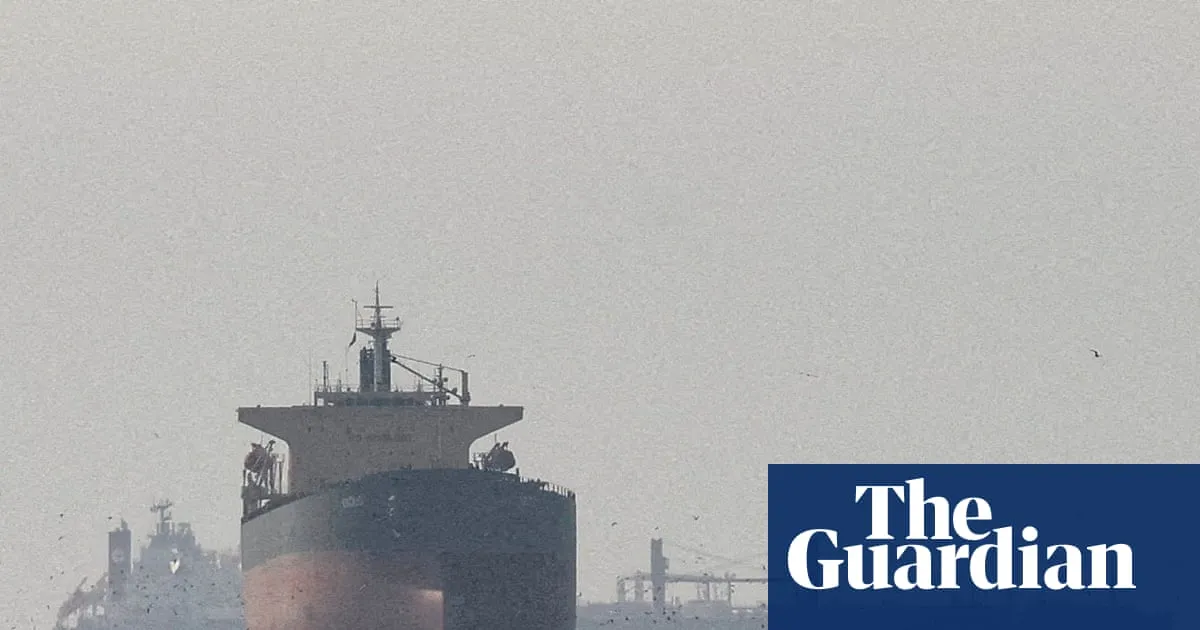
Iran has been in discussion with Oman about the creation of a new temporary route through the Strait of Hormuz that would allow commercial shipping to resume, but is not yet reviving talks with the US, Tehran’s foreign ministry spokesperson said on Monday.Esmail Baghaei was responding to claims by Donald Trump that talks between the two sides covering all the major disputes between them could restart as early as Monday. Trump claimed he held off from launching the biggest strike on any country “since world war two” over the weekend after Saudi Arabia’s crown prince, Mohammed bin Salman, rang him to urge diplomacy. Trump said the cancellation was conditional on Iran reaching a deal quickly.It is thought to be the 12th time in the war between the US and Iran that Trump has called off threatened strikes.Baghaei’s discussion of a new middle route through the strait of Homuz would represent progress. Iran is claiming full sovereignty over the strait and has been making demands over the routes and future management of the strait, including the possibility of charging fees in return for providing ships with maritime services.One proposal is to create an Omani-Iranian joint company that would provide all the services that insurance companies used to provide at high costs, but at lower prices, and with preferential tariffs for some countries.Unlocking a mutually acceptable route through the strait is the precondition to unlocking all the other agreements laid out in the memorandum of understanding, the ceasefire document both sides signed on 18 June. Disagreements about the memorandum’s obligations has led to a resumption of the war, which has spread to the Red Sea and to Iraq.Last week, Iran’s deputy foreign minister, Kazem Gharibabadi, said Iran was demanding that ships entering the strait take a route to the north close to Iran, but that some ships could take a southern route. Iran rejected the traffic being divided evenly between the two routes, and also that a third country could start de-mining the routes.Baghaei told a press conference in Tehran: “We are now talking about a corridor that will have a round trip route, not two or three separate routes. This intermediate route is to be used temporarily until a decision is made on a fixed route”.He framed the route as an alternative to the Transport Separation Scheme, the previous longstanding prewar route overseen by the UN’s International Maritime Office. He said maps had been exchanged by the two sides.Baghaei stressed that the talks with Oman were bilateral and did not involve the US, adding the negotiations with Oman had lasted seven to eight days. Iran’s foreign minister, Abbas Araghchi, was not due to hold any talks with the US on Monday, he said.He said: “We are focused on reaching an understanding on a route that will ensure safe shipping traffic through the Strait of Hormuz. Our effort is to determine a route at the earliest opportunity, with Oman’s consultation and cooperation; a route that will usually be temporary and based on which we can provide shipping in the Strait of Hormuz.”He said an agreement on a route would not solve all the problems, pointing to the continuing US naval blockade of Iran’s ports, adding that unless the US approach changed, there would be no significant improvement in the situation in the Strait of Hormuz.Baghaei implied the talks with Oman would extend beyond a safe route to include future management of the strait. He said: “As a rule, in any understanding regarding shipping traffic between two coastal states, all issues related to the sovereignty and sovereign rights of the two countries, as well as issues of national security, national interests, and issues related to maritime services, are definitely considered and examined.”Recently there had been gloom in Omani circles about reaching an agreement with Iran on routes, leading to a revival of preparations for Oman’s European allies to start to clear the southern route of mines, a step that might have provoked direct conflict between Iran and European powers.Baghaei blamed the US for disregarding the memorandum of understanding by attempting to open up a southern route through Omani waters, arguing that article 5 of the memorandum specified that Iran alone within 30 days was required to return the level of shipping traffic to prewar conditions.He said ships that passed through this Oman route “were moving under pressure from Centcom, and due to intimidation from the American side. Some of these ships were even carrying military equipment, and in the shelter of these large ships, sometimes frigates also traveled.“On 21 and 22 June, the US carried out widespread attacks against Iran and suddenly announced that everything was over under the pretext of the incident of seeing several ships in the Strait of Hormuz.”In a sign of the pressure Tehran diplomats face, a statement from the Assembly of Experts warned againt investing any trust in the US, saying: “Hope for understanding and agreement with this bullying regime will lead nowhere.” A section of the statement read: “It is incumbent upon all the free people in every corner of the world to keep aloft the banner of revenge and retribution for the martyred Imam.”But the Iranian president, Masoud Pezeshkian, said he believed the “memorandum of understanding would prove to be the centre of gravity of our foreign relations in the future”.Saudi intervention came in a week in which Riyadh attacked Iranian-backed forces inside Iraq and raised the temperature in its dispute with the Iranian-backed Houthis in northern Yemen, underlining the extent to which Saudi Arabia fears the consequence of an all-out US war against Iran spiralling out of control across the Middle East.
SRCThe Guardian - World News
LANGEN
LEANCenter-Left
WORDS937
ENT12
MON · 2026-08-03 · 11:52 GMTBRIEF NSR-2026-0803-98615
NSR-2026-0803-98615News Report·EN·Diplomatic
Iran in talks with Oman over shipping route but not US, says Tehran
Iran is in discussions with Oman to establish a temporary shipping route through the Strait of Hormuz to resume commercial traffic. This initiative is separate from any potential talks with the United States, according to Iran's foreign ministry spokesperson.
Patrick Wintour Diplomatic editorThe Guardian - World NewsFiled 2026-08-03 · 11:52 GMTLean · Center-LeftRead · 4 min
The Guardian - World NewsFIG 01
Reading time
4min
Word count
937words
Sources cited
3cited
Entities identified
12entities
Quality score
100%
§ 01
Briefing Summary
AI-generatedNEWSAR · AI
Iran is in discussions with Oman to establish a temporary shipping route through the Strait of Hormuz to resume commercial traffic. This initiative is separate from any potential talks with the United States, according to Iran's foreign ministry spokesperson. The discussions with Oman, which have lasted seven to eight days, aim to create a single round-trip corridor as an alternative to the previous UN-overseen route. Iran claims full sovereignty over the strait and is seeking to manage its routes and services, potentially through a joint Omani-Iranian company. This move comes amidst ongoing tensions with the US, with Iran asserting that an agreement on a route would not resolve all issues, citing the US naval blockade of its ports.
Confidence 0.90Sources 3Claims 5Entities 12
§ 02
Article analysis
Model · rule-basedFraming
Diplomatic
Conflict
Tone
Measured
AI-assessed
CalmNeutralAlarmist
Factuality
0.70 / 1.00
Factual
LowHigh
Sources cited
3
Well sourced
FewMany
§ 03
Key claims
5 extracted01
Iran is in discussions with Oman regarding a new temporary shipping route through the Strait of Hormuz.
factualTehran’s foreign ministry spokesperson
Confidence
1.00
02
Iran rejected dividing traffic evenly between northern and southern routes or allowing a third country to de-mine routes.
factualIran’s deputy foreign minister
Confidence
0.90
03
Iran is claiming full sovereignty over the Strait of Hormuz and has demands regarding its routes and management.
factual
Confidence
0.90
04
Donald Trump claimed he called off a major strike on Iran over the weekend after urging from Saudi Arabia's crown prince.
quoteDonald Trump
Confidence
0.90
05
A proposal includes creating an Omani-Iranian joint company for maritime services at lower costs.
factual
Confidence
0.80
§ 04
Full report
4 min read · 937 words§ 05
Entities
12 identifiedKey playerOppositionContextPositiveNeutralNegative
People4
Organizations1
§ 06
Keywords & salience
8 termsstrait of hormuz
1.00
shipping route
0.90
iran-us talks
0.80
oman
0.70
maritime services
0.60
ceasefire document
0.50
memorandum of understanding
0.50
transport separation scheme
0.40
§ 07
Topic connections
Interactive graph Network visualization showing 51 related topics
View Full Graph Person Organization Location Event|Click node to navigate|Edge numbers = shared articles