EXPLAINERThe Mecca defence pact combines a top oil exporter, NATO’s second-largest army and the only nuclear-armed Muslim country.Published On 11 Aug 2026Leaders of Saudi Arabia, Turkiye and Pakistan signed the Mecca Joint Defence Agreement last Friday, pledging to strengthen collective deterrence against any act of aggression and stating that an armed attack on any one of the three would be regarded as an attack on all.The pact comes as the three countries navigate growing regional tensions, including concerns over Israel’s expanding military reach and Iran’s regional influence.Recommended Stories list of 4 itemslist 1 of 4Which other countries could join the Turkiye-Saudi-Pakistan defence pact?list 2 of 4The Mecca pact is not just another regional alliancelist 3 of 4Where does Iran stand on Saudi-Pakistan-Turkiye pact?list 4 of 4Iran changed the rules in Hormuz. The Gulf is changing the rules for Iranend of listTogether, these countries form a sizeable military bloc. Riyadh is a top oil exporter, Ankara has NATO’s second-largest military, and Islamabad is the only nuclear-armed Muslim country.In this explainer, Al Jazeera breaks down their combined land, air and naval strength.Saudi Arabia’s Crown Prince Mohammed bin Salman, flanked by Turkiye’s President Recep Tayyip Erdogan, left, and Pakistan’s Prime Minister Shehbaz Sharif, right, signing a joint defence agreement in Mecca, on August 7, 2026 [Handout/Turkish Presidency Press Office via AFP]Joint land, air and naval strengthTogether, the three countries combine nearly 1.4 million active military personnel, 3,400 aircraft, 6,000 tanks and more than 340 naval assets according to the 2026 Global Firepower Index, which ranks the defence capabilities of 145 countries.The index scores each country’s potential war-making capability across land, air and sea, drawing on factors including manpower, equipment, natural resources, finances and geography. Manpower: Combined, the three countries include about 1.4 million active personnel, backed by large paramilitary and reserve forces. Pakistan provides the largest pool of active personnel at 660,000, followed by Turkiye at 481,000 and Saudi Arabia at 247,000. Air power: Together they operate 3,415 military aircraft including fighter jets, helicopters, transporters and training military aircraft. Pakistan possesses some 1,397 aircraft, followed by Turkiye at 1,101 and Saudi Arabia with 917. Land forces: The three countries field some 6,046 tanks and more than 179,000 armoured vehicles, alongside thousands of artillery systems and multiple-launch rocket systems. Pakistan has the highest number of tanks at 2,677, Turkiye has 2,284 and Saudi Arabia, 1,085. Naval power: Their combined fleets include 344 naval assets, including 33 frigates, 24 corvettes and 22 submarines. Turkiye comes out top here with 192 naval assets, followed by Pakistan’s 120 and Saudi Arabia’s 32. Defence spending: Their combined defence budgets amount to about $124.4bn annually. Saudi Arabia has the largest military budget of the three at $63.9bn in 2026, while Turkiye set aside $51.4bn and Pakistan $9.1bn according to Global Firepower. Pakistan-made surface-to-surface missiles Fatah-I and launcher are displayed during a military parade to mark Pakistan National Day in Islamabad, Pakistan, on March 23, 2024 [AP Photo]Complementary military powersAndreas Krieg, an academic, security analyst and political risk consultant specialising in the Middle East and North Africa, said the pact’s significance lies in how the three countries’ different capabilities could complement one another.“Saudi Arabia contributes capital, geography, infrastructure and political convening power. Turkiye contributes an increasingly sophisticated defence-industrial base, drones, missiles, sensors, electronic warfare, naval systems and NATO-derived military expertise,” he said.Meanwhile, Pakistan contributes manpower, a large professional military establishment, operational experience, defence production and nuclear capability.Turkish navy vessels navigate the Bosphorus in a parade to mark the 486th anniversary of the Naval victory of Preveza and Naval Forces Day on September 27, 2024, in Istanbul, Turkiye [Chris McGrath/Getty Images]What does the alliance mean for each country?For Saudi Arabia, the pact diversifies its defence partnerships beyond the United States, adding Turkiye’s advanced military capabilities and Pakistan’s nuclear deterrent, amid growing threats to vital maritime corridors such as the Strait of Hormuz and Bab al-Mandeb.Pakistan is one of nine states that possess nuclear weapons, which it first tested in 1998. The country of more than 250 million people relies heavily on China for its arms imports.Turkiye, which joined NATO in 1952, has no nuclear weapons of its own but hosts US warheads under NATO nuclear-sharing arrangements.David Des Roches, a former director of Arabian Peninsula affairs in the US Department of Defense, told Al Jazeera that the deal also serves Saudi arms diversification amid Western export unpredictability, since Turkiye and Pakistan can supply items like 155mm artillery shells at scale.For Turkiye and Pakistan, it opens Saudi financial markets for their defence industries – both have manufacturing capacity exceeding what their own economies can sustain.Zaid M Belbagi, managing partner at Hardcastle Advisory, told Al Jazeera that, for the US, the stakes are high. “Pakistan is a recipient of US aid, Saudi Arabia is the largest foreign buyer of US military equipment, and Turkiye is NATO’s second-largest army after the United States – so the spectre of the US within this agreement is quite interesting,” he said.Krieg added that the US remains highly important, particularly for intelligence, advanced missile defence, and high-end military technology – but said that regional actors want to convert their own resources into usable power rather than purchasing from Washington.“The old model was overwhelmingly hub-and-spokes, with Washington at the centre and individual states looking primarily to the United States for security. What is emerging now is horizontal connectivity between regional powers,” said Krieg.Egypt is the only country whose potential membership has been publicly raised by a signatory. Turkiye’s Foreign Minister Hakan Fidan called Egypt a “natural partner” and said he expected Cairo to join once technical issues are resolved.Krieg said Egypt’s military weight, strategic geography and control of the Suez Canal would make it a significant addition to the pact.But Cairo may be wary of binding military obligations and the impact on its existing agreements, analysts said. “Egypt may join only if the language protects its aid relationship with Washington, doesn’t undermine existing alliances and peace treaties, and maintains its own freedom to decide when and where it fights,” said Karim Elgendy at Chatham House.
SRCAl Jazeera
LANGEN
OutletState media · Qatar
WORDS1,005
ENT11
TUE · 2026-08-11 · 13:47 GMTBRIEF NSR-2026-0811-101212
NSR-2026-0811-101212Analysis·EN·National Security
What are Saudi Arabia, Turkiye and Pakistan’s joint military capabilities?
Saudi Arabia, Turkiye, and Pakistan have signed the Mecca Joint Defence Agreement, pledging collective deterrence against aggression. This pact combines Saudi Arabia's status as a top oil exporter, Turkiye's large NATO military, and Pakistan's nuclear arsenal.
Alia Chughtai,Marium AliAl JazeeraFiled 2026-08-11 · 13:47 GMTOutlet · State media · QatarRead · 5 min
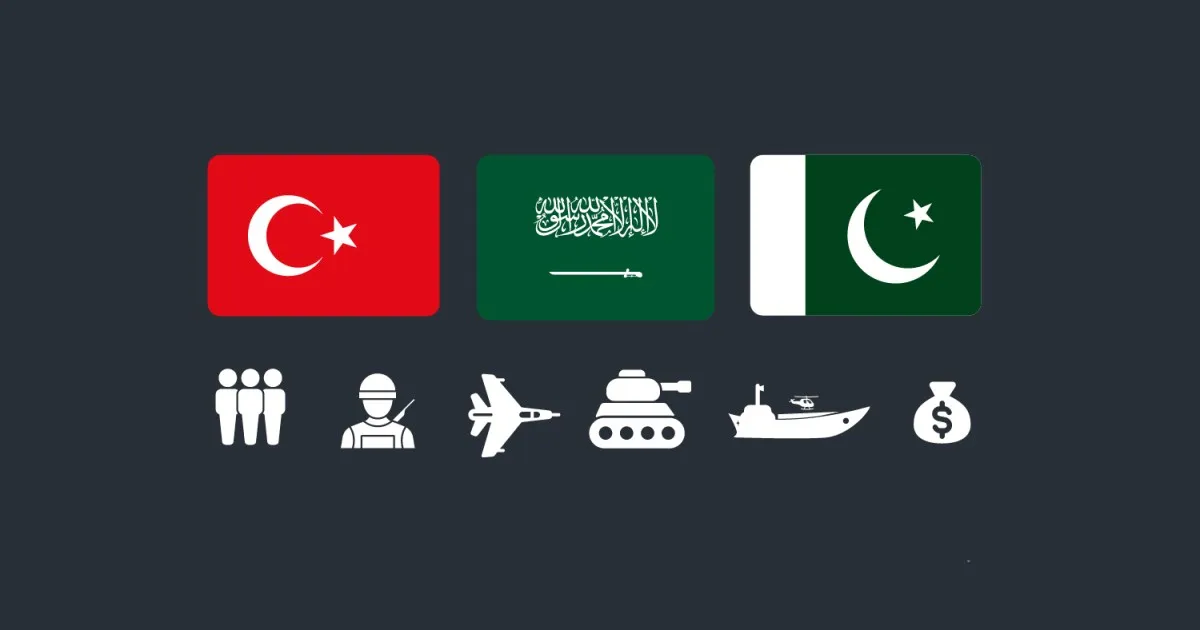
Al JazeeraFIG 01
Reading time
5min
Word count
1,005words
Sources cited
1cited
Entities identified
11entities
NEWSAR · AI
Saudi Arabia, Turkiye, and Pakistan have signed the Mecca Joint Defence Agreement, pledging collective deterrence against aggression. This pact combines Saudi Arabia's status as a top oil exporter, Turkiye's large NATO military, and Pakistan's nuclear arsenal. Together, the three nations possess nearly 1.4 million active military personnel, over 3,400 aircraft, 6,000 tanks, and more than 340 naval assets, with a combined annual defense spending of approximately $124.4 billion. The agreement aims to strengthen their collective security amidst growing regional tensions, including concerns over Israel's military reach and Iran's influence. The pact leverages complementary strengths, with Saudi Arabia contributing capital and convening power, Turkiye offering advanced defense industries and NATO expertise, and Pakistan providing manpower, operational experience, and nuclear capability.
Confidence 0.90Sources 1Claims 5Entities 11
Framing
National Security
Political Strategy
Tone
Measured
AI-assessed
CalmNeutralAlarmist
Factuality
0.80 / 1.00
Factual
LowHigh
Sources cited
1
Limited
FewMany
01
The pact aims to strengthen collective deterrence against any act of aggression, with an attack on one considered an attack on all.
factual
Confidence
1.00
02
Saudi Arabia, Turkiye, and Pakistan signed the Mecca Joint Defence Agreement, pledging collective deterrence against aggression.
factual
Confidence
1.00
03
Their combined defence budgets amount to about $124.4bn annually.
statistic
Confidence
0.90
04
Pakistan has the largest pool of active personnel (660,000), followed by Turkiye (481,000) and Saudi Arabia (247,000).
statistic2026 Global Firepower Index
Confidence
0.90
05
Together, the three countries have nearly 1.4 million active military personnel, 3,400 aircraft, and 6,000 tanks.
statistic2026 Global Firepower Index
Confidence
0.90
§ 04
Full report
5 min read · 1,005 wordsKey playerOppositionContextPositiveNeutralNegative
People3
Organizations1
Locations5
mecca joint defence agreement
1.00
collective deterrence
0.90
regional tensions
0.80
military capabilities
0.70
pakistan
0.60
saudi arabia
0.60
turkiye
0.60
iran's regional influence
0.50
nuclear-armed muslim country
0.40
global firepower index
0.40
§ 07
Connections
Who appears together in the newsIn this articleWider coverageLine weight = articles in common
Laying out network…
Strongest ties articles in common
- 6,840
- 1,279
- 1,097
- 640
- 638
- 512
Recurring context not named in this article
- PDonald Trumplinks 10
- OHouthislinks 10
- LStrait of Hormuzlinks 10
- LYemenlinks 10
- LMiddle Eastlinks 10
- LUnited Stateslinks 10
- LEgyptlinks 10
- LFrancelinks 10